

Key takeaways
- Lighting a tree with solar power sounds simple until you stand in the yard and realize the tree is the problem.
Lighting a tree with solar power sounds simple until you stand in the yard and realize the tree is the problem. A mature canopy blocks the sun the panels need, trunks vary from slim birches to wide oaks, and the question of whether you want a spotlight glowing up through the branches or a string of lights wrapped around them changes everything about what to buy. The phrase “outdoor solar lights for trees” really bundles two very different jobs: uplighting a tree from the ground, and decorating a tree with lights that hang or wrap.
This guide is for homeowners lighting a front-yard maple, a backyard fruit tree, a flagpole-adjacent evergreen, or a holiday display, and it covers both approaches. Six options range from two-pack high-output spotlights to a forty-foot solar string. Each is judged from what its listing states, such as the number of LEDs, lighting modes, waterproof rating, and mounting method. Planning a seasonal setup for the 2026 holidays means picking a format early, because the right choice depends on whether the tree stands in full sun.
Quick Picks
Our top picks


As an Amazon Associate we earn from qualifying purchases at no extra cost to you.
| Product | Best for | Key spec taken from the title |
|---|---|---|
| NYMPHY Solar Spot Lights, 4 Pack | Warm uplighting on several trees | 56 LEDs, IP68 waterproof, 3 modes |
| Minetom Solar String Lights, 40 FT | Wrapping a tree for the holidays | 100 LEDs, 8 lighting modes, IP65 |
| JEJOT Solar Spot Lights, 6 Pack | Focused beams on tall trunks | Focus beam, listed for flag tree use |
| Focusing RGB+3CCT Tree Uplights, 4 Pack | Color-changing accents | Multicolor focused lens, dusk to dawn |
| nipify Solar Spot Lights, 4 Pack | Flexible panel placement | 53 LEDs, adjustable solar panels, IP65 |
| Linkind Starray Solar Spotlights, 2 Pack | Bright, warm focal lighting | 650 lumens, 3000K, in-ground or wall mount |
How to Choose
Decide between uplighting and decorating
Spotlights stake into the ground and aim up through the branches, which makes them ideal for permanent, year-round accents. String lights wrap trunks and branches and suit seasonal displays. A common rule: one spotlight handles a tree up to about 15 feet, while taller trees or wide canopies need two spotlights angled from opposite sides. For a string, count how many wraps you plan, because a 40-foot string covers a small tree generously but only half of a large one.
Check the solar panel exposure
A panel needs roughly six hours of direct sun to fill the battery, and tree shade can ruin that. Look for lights with adjustable panels or a panel you can place separately, so the light sits under the tree while the panel sits in full sun. If the listing does not mention panel flexibility, assume the panel is attached to the light head and place it where sun reaches. Sets with auto on and off at dusk save manual switching. In practice, a tree that gets only a couple of hours of direct light will run its lights for far shorter than the listing suggests.
Understand waterproof ratings and brightness
IP65 handles rain and splashing. IP68 covers continuous submersion, which is far more than a lawn light needs, but it signals better sealing against snow and sprinklers. For brightness, a listed lumen figure is more reliable than LED count: 650 lumens is bright enough to light a tree trunk, while dozens of small LEDs spread their output more softly. Warm white at 3000K flatters bark and leaves; cool white looks harsher.
Look at modes and mounting
Multiple modes sound appealing, but steady-on is what most trees need. Extra modes such as flashing or twinkling are useful on holiday strings. Mounting matters too: stake-only lights suit soft soil, while wall-mount options help on hardscape or fences. Budget models cut corners with thin plastic stakes and batteries that fade by midnight in winter, so treat long-run claims with caution. Spending a few more minutes checking mounting hardware and panel placement saves more frustration than any extra mode will.
The 6 Best Options
NYMPHY Solar Spot Lights, 4 Pack
Four warm white spotlights, each with 56 LEDs, three lighting modes, and an IP68 waterproof rating. The warm tone flatters trunks and foliage, and a four-pack covers several trees or one wide canopy from multiple angles. It is the straightforward option for buyers who want an even, warm glow without any tuning. Stake one on each side of a trunk and you have a symmetrical, welcoming look at the front of the house, or spread them across a small orchard and give each tree its own pool of light.
- Strength: IP68 sealing suggests strong protection against rain and snow.
- Strength: four lights give enough coverage for multiple trees or angles.
- Trade-off: the title does not state a lumen figure, so brightness is hard to compare.
Skip it if the tree is tall and you need a documented high-output beam.
Minetom Solar String Lights, 40 FT
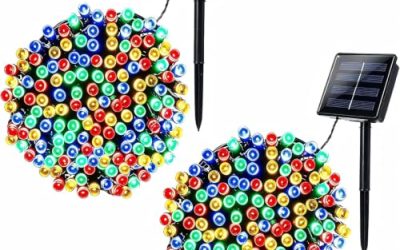
A forty-foot solar string with 100 LEDs and eight lighting modes, with an IP65 waterproof rating. It is billed for solar fairy and Christmas use, making it a seasonal decorator more than a spotlight. Eight modes give a range of display patterns that suit holiday setups, and the string format means you can drape it over low branches by hand instead of aiming a beam.
- Strength: eight modes let you switch from steady glow to festive patterns.
- Strength: 40 feet is enough to wrap a small tree trunk and lower branches.
- Trade-off: the title does not describe the solar panel size, so charge time is uncertain.
Skip it if you want a permanent, year-round uplight rather than a decoration.
JEJOT Solar Spot Lights, 6 Pack
Six spotlights with a focus beam, listed for use on a flag or tree, with two lighting modes. The focused beam is the distinguishing feature: it concentrates light rather than flooding it, which helps with tall trunks and flagpole-style subjects. Six units offer flexibility to light a line of trees along a driveway. Homeowners with a flagpole near their trees will like the listing’s mention of that use, since pole and trunk subjects share the same narrow, tall profile.
- Strength: a focused beam pushes light higher than a wide flood lens.
- Strength: six lights cover a row of trees or multiple angles.
- Trade-off: only two lighting modes, which limits decorative options.
Skip it if you prefer a wide, soft wash of light over a narrow beam.
Focusing RGB+3CCT Tree Uplights, 4 Pack
Four uplights with multicolor RGB output and three color temperatures, a focused lens, and dusk-to-dawn operation, mountable on a stake or wall. It lets you run a warm white for everyday use and switch to color for holidays. The focused lens targets tree trunks and canopies directly. Dusk-to-dawn operation means the lights switch on automatically, so changing from everyday warm white to a seasonal color is the only manual step.
- Strength: RGB plus three color temperatures offers the widest range of looks here.
- Strength: stake or wall mounting adapts to lawns, fences, and hard surfaces.
- Trade-off: more color options usually mean a more complex control scheme.
Skip it if you only want a plain, warm white glow with no settings.
nipify Solar Spot Lights, 4 Pack
Four warm white uplights with 53 LEDs each, three modes, auto on and off, and IP65 waterproofing. Adjustable solar panels are the highlight, since you can tilt them toward the sun even when the light sits under a canopy. That flexibility solves the main problem of lighting a shaded tree. It also helps on lots where the best sun is across the yard from the best viewing angle, because the panel and the light do not have to share the same spot.
- Strength: adjustable panels help in partial shade.
- Strength: auto on and off removes daily manual operation.
- Trade-off: IP65 is lower than the IP68 on some competing listings.
Skip it if your lights will sit in a place prone to heavy standing water or if you want the highest waterproof rating in the group.
Linkind Starray Solar Spotlights, 2 Pack
A two-pack of warm white spotlights listed at 650 lumens and 3000K, with three modes, dusk-to-dawn operation, and in-ground or wall-mount options. The concrete lumen figure helps compare it against others, and it targets buyers who want brighter, tidier accents on fewer trees. The in-ground and wall-mount choices also let you place lights against a fence or house next to a favorite tree, not only in a lawn.
- Strength: a stated 650 lumens makes brightness easy to evaluate.
- Strength: 3000K warm white flatters bark and leaves.
- Trade-off: a two-pack covers fewer trees than the four- and six-packs.
Skip it if you have many trees to cover and want the lowest cost per light.
Which One Fits Your Situation
You have a shaded tree in the back
The nipify Solar Spot Lights 4 Pack, with its adjustable panels, can capture sun from a separate spot while the light sits under the canopy. That makes it the practical answer for the classic problem of a big shade tree beside a sunny patio.
You are decorating for the holidays
Choose the Minetom 40 FT string for wrapping, or the Focusing RGB+3CCT uplights if you want red and green color washes. The string suits a close-up look on a trunk, while the uplights create a wide glow from a distance.
You want strong, warm focal lighting on one or two trees
Go with the Linkind Starray 2 Pack, since its listed 650 lumens and 3000K tone suit a statement tree.
You have a row of trees along a driveway
The JEJOT 6 Pack covers the distance with a focused beam that reaches up each trunk, while the NYMPHY 4 Pack suits a smaller group.
Common Mistakes
- Placing a panel under the canopy and then blaming the light for dimming by midnight.
- Choosing on LED count alone and ignoring lumens or beam style.
- Using a string light where an uplight would give a cleaner, permanent result.
- Ignoring that winter sun is weaker and shorter, which shrinks runtime.
- Staking lights into compacted or rocky soil without a wall-mount backup.
Specs and Terms Explained
IP ratings
The first digit of an IP code covers dust and the second covers water. A rating such as IP65 describes dust-tight construction that resists water jets, which is a reasonable goal for lights left in rain all year. Lower water ratings only promise protection from splashes, so they belong under a covered porch rather than on an open lawn.
Lumens and why they mislead
Lumens measure total light output, but the spread of the beam matters just as much for a tree. A narrow spotlight concentrates its output on one trunk, while a wide flood spreads the same output thin across a canopy. Do not compare lumen figures across different beam types.
Color temperature and CCT
Color temperature is measured in kelvins. Roughly 2700K to 3000K is a warm amber glow that flatters bark and evergreens, while 5000K and above reads as cool white. Products with a “3CCT” label, like the Focusing RGB+3CCT Tree Uplights, are described as offering three white tones, and RGB means colored output for seasonal scenes.
Panel and battery capacity
Spec sheets list battery capacity in mAh and sometimes panel wattage. Larger numbers suggest longer run times after a bright day, but the panel’s real output depends on the light it receives, so a big battery with a tiny panel in shade will still fall short.
Setup and Care Tips
- Leave each light in a sunny spot for a full day before installing it, so the battery starts charged and any defective unit shows up early.
- Set the switch to ON before pushing stakes into the ground; many units ship in the off position.
- Aim spotlights from the base of the trunk at a slight angle toward the canopy. Placing them a foot or two away gives a wider wash than pressing them against the bark.
- Wipe the solar panel with a damp cloth every month or two. Pollen, dust, and bird droppings quietly cut charging.
- Trim grass and low shrubs around spikes so leaves do not shade the panel.
- For the Minetom Solar String Lights, loosely spiral them around branches instead of cinching them tight, since trees grow and bark swells.
Who Should Skip These
Solar tree lights are not the right choice for a tree sitting in permanent shade with no sunny spot nearby, since panels cannot charge there. Spike-style units like the NYMPHY, JEJOT, and nipify spotlights suit that situation only if the panel can be placed away from the tree on a separate lead, so check the cable length in the listing first. In regions with long dark winters, expect dimmer output and shorter run times because the panel receives less energy, and consider a wired low-voltage kit if reliability matters more than convenience.
Skip string lights if you want a clean, architectural look; skip uplights if you want twinkling holiday sparkle. If you need to light a very tall tree, small stake lights will only reach the lower trunk and first branches, and a more powerful fixture on a pole or stake mount is the better direction.
Related guides
- White Elephant Gift Exchange Rules Explained
- How To Host A Tacky Christmas Sweater Party
- Ugly Christmas Sweaters For Adults
Frequently Asked Questions
How many spotlights does one tree need?
For most trees up to about 15 feet, one or two lights are enough. Larger or wider trees look better with two or three spotlights angled from different sides.
Do solar tree lights work in winter?
They do, but with shorter runtime, since days are shorter and the sun sits lower. Keep panels clear of snow and shade for best results. A quick wipe after a storm can restore a surprising amount of charging.
Is IP65 enough for a tree light?
For most yards, yes. It handles rain and spray. IP68 adds extra sealing and suits spots near sprinklers or heavy snow.
Can I use the same lights year-round?
Spotlights can stay in place all year. String lights are better stored after the holidays to protect the wiring, and a quick check of the stakes each spring keeps spotlights pointing the right way.





Write Your Review
No reviews yet. Be the first to share your experience!