

Key takeaways
- Three triple-output bench power supplies with settable overvoltage protection: two Korad linear units and the Rigol DP832, with channel and spec checks.
A triple-output bench supply is easy to buy and easy to buy wrong. The real decision is not the channel count on the box; it is whether the supply will cut a channel off when a knob slips, a lead shorts, or a rail is dialed past what your board can survive. Overvoltage protection is the feature that turns a wiring mistake into a shutdown instead of a dead prototype, so it should be settable, per channel, and easy to reach.
This guide serves hobbyists, repair benches, and small labs that power a logic rail and analog rails from one box. Every pick below is a three-output bench power supply whose listing or reproduced listing material states overvoltage protection, chosen from the channel layout, protection wording, and control features printed with the listing itself.
Quick Picks
As an Amazon Associate we earn from qualifying purchases.
| Product | Best for | Key spec |
|---|---|---|
| KORAD KA3305D | A first triple-output bench for everyday electronics work | Two 30 V / 5 A channels plus a fixed 5 V / 3 A rail |
| KORAD KA3305P | Benches that repeat the same rail settings from a PC | USB and RS232 control with stored parameter sets |
| Rigol DP832 | Programmable rails with layered protection on each output | OVP, OCP and OTP protection, 195 W total output |
How to Choose
What the OVP Trip Point Actually Does
Overvoltage protection is a ceiling you set separately from the output voltage. Dial a rail to 12 V, set OVP at 13 V, and the supply shuts that channel down if the output ever climbs past the ceiling, whether the cause is a slipped knob, a wrong memory recall, or a fault inside the supply. Look for OVP that is settable per channel from the front panel, like the dedicated OVP set button on the Korad units, rather than a fixed internal threshold you cannot adjust or even see.
Channel Layout and the Third Rail
Most triple-output supplies pair two adjustable channels with one fixed rail. The Korad pair gives you two 0–30 V, 0–5 A channels plus a fixed 5 V / 3 A rail, while the Rigol DP832 trades current for a 195 W programmable design with two 30 V / 3 A channels. Decide which pattern matches your work: high current for motors, heaters, and charging tasks, or finer control for mixed-signal boards. Also check whether the third rail is adjustable at all, because a fixed 5 V output cannot become a 3.3 V rail later.
Isolation and Shared Grounds
Three outputs do not always mean three floating outputs. On the Rigol DP832, one 30 V channel shares a common ground connection with the 5 V channel, which matters when you wire split rails for op-amp circuits or stack channels for a higher voltage. The Korad channels can be linked in series or parallel modes, and in those modes one channel becomes the master whose limits govern both. Read the grounding and linking rules for any supply before you plan a ±15 V analog setup around it, not after the board is wired.
Programming, Memory, and Remote Control
If your bench repeats the same voltages daily, stored settings save real time and prevent dialing errors. The KA3305D holds five panel memory settings, the KA3305P adds USB and RS232 control with a deep bank of stored parameter sets for programmed recall, and the DP832 brings USB and LAN control for scripted sequences. Programming also interacts with protection: recalling a stored setup recalls its limits too, so store each setup with the OVP ceiling your board needs already in place, and confirm the ceiling on the display before enabling the output.
The 3 Best Options
KORAD KA3305D
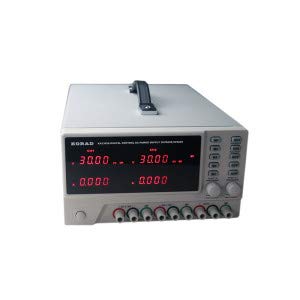
The KA3305D fits a first serious bench or a repair desk that needs three rails without a steep learning curve. Two adjustable channels deliver 0–30 V at up to 5 A each, enough for power stages, small motors, and automotive modules, while the fixed 5 V rail runs logic boards alongside. Its linear, transformer-based design keeps output noise low for audio and sensor work, and the front panel carries a dedicated OVP set control, so the voltage ceiling for each adjustable channel is a deliberate setting rather than an afterthought.
Specs
- Two adjustable channels, 0–30 V and 0–5 A each
- Third channel fixed at 5 V / 3 A
- Linear, transformer-based regulation
- 4-digit LED displays, 10 mV / 1 mA resolution
- Settable overvoltage and overcurrent protection on the adjustable channels
- Five memory settings for fast recall
- Listed output wattage 150 W; 15 lb; 8.67 × 6.1 × 10.25 in
- Includes two sets of test leads, power cord, and manual; 2-year warranty
Best for: Everyday repair and prototyping that needs two strong adjustable rails plus a logic rail, with a settable voltage ceiling guarding each main channel.
Watch out for: The fixed 5 V channel has no settable OVP of its own, so put boards that need a guarded ceiling on the adjustable channels instead.
KORAD KA3305P

The KA3305P suits benches where the same rail combinations come back day after day and a PC is already part of the workflow. It keeps the KA3305D layout of two 0–30 V, 0–5 A channels and a fixed 5 V rail, then adds complete digital control: USB and RS232 interfaces, a large bank of stored parameter sets for programmed recall, and remote sense terminals that compensate for voltage drop along the leads. OVP and OCP limits are settable per adjustable channel, so a stored routine can carry its own ceiling for the board it powers.
Specs
- Two adjustable channels, 0–30 V and 0–5 A each
- Third channel fixed at 5 V / 3 A and always on
- Setting and readback resolution of 10 mV / 1 mA
- USB and RS232 interfaces for PC control
- 100 stored parameter sets for programmable recall, plus panel memories
- Settable OVP and OCP limits on each adjustable channel
- Series mode up to roughly 60 V; parallel mode up to roughly 10 A
- Remote measurement terminal compensates for lead voltage drop
Best for: Repeatable bench routines and PC-driven setups that recall stored rails together with the OVP ceiling each board requires.
Watch out for: The PC software can reset output settings when it connects, so set your OVP and OCP limits after linking the software and before connecting a board.
Rigol DP832

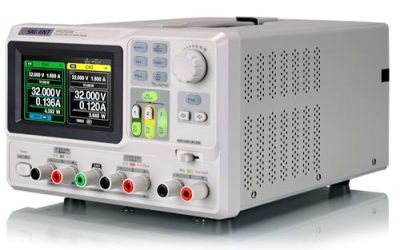
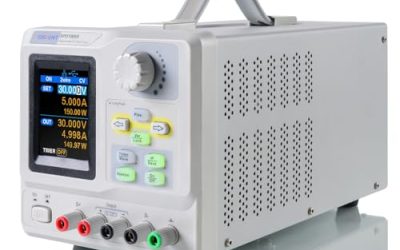
The DP832 fits mixed-signal and development work where protection depth and programmability matter more than raw current. Its two 30 V / 3 A channels and 5 V / 3 A third channel deliver 195 W in total, and the protection set runs three layers deep: overvoltage, overcurrent, and overtemperature protection watch the outputs while you work. USB and LAN interfaces put the supply on the bench network for scripted bring-up sequences, data logging habits, and shared lab use, and the programmable design lets each channel’s limits be part of a stored, repeatable configuration rather than a manual habit.
Specs
- Two adjustable channels, 0–30 V / 3 A each
- Third channel, 5 V / 3 A
- 195 W total output
- Overvoltage, overcurrent, and overtemperature protection
- USB and LAN remote interfaces
- Programmable, with per-channel output control
- LCD readout of voltage, current, and power per channel
- Linear programmable design for low-noise rails
Best for: Development benches that want layered OVP, OCP, and OTP protection plus network control over three programmable rails.
Watch out for: One 30 V channel shares a common ground with the 5 V channel, so the trio is not fully floating; check your grounding plan before wiring split rails.
Which One Fits Your Situation
Powering a Logic Board and Analog Rails Together
Pick the KORAD KA3305D. The fixed 5 V rail runs your logic board while the two adjustable channels carry the analog rails, each with its own settable OVP ceiling. That separation is the everyday pattern for mixed boards, and the Korad gives you a full 5 A per main channel for the hungry parts of the circuit without paying for programming features you may never open.
Bringing Up a Board You Cannot Afford to Lose
Pick the Rigol DP832. A one-off prototype deserves the deepest protection set here: overvoltage, overcurrent, and overtemperature protection, with limits that live inside a stored configuration. Set the OVP ceiling a little above each rail before the first power-up, and the supply will cut a channel rather than let a wrong setting or a fault reach the board.
Running the Same Rail Sequence Every Day
Pick the KORAD KA3305P. Its USB and RS232 control and deep bank of stored parameter sets exist for exactly this pattern: recall the routine, confirm the recalled OVP limits on the display, and enable the outputs. Remote sense keeps the delivered voltage honest at the end of long leads, which matters when the same fixture runs the same board all week.
Needing More Than 30 V or 5 A From One Output
Pick the KORAD KA3305P and use its linking modes. Series mode combines the two adjustable channels toward roughly 60 V for higher-voltage work, and parallel mode heads toward roughly 10 A for heavier loads. Remember that in linked modes the master channel’s protection limits govern both channels, so set the OVP ceiling for the combined output before you enable it.
Common Mistakes
- Setting the voltage first and the OVP ceiling later; the ceiling should be in place before the output is ever enabled on a new board.
- Assuming the fixed 5 V rail has the same protection as the adjustable channels; on the Korad units it does not carry a settable OVP.
- Recalling a stored setup without checking its limits, even though memory recall brings back the stored OVP and current settings with the voltages.
- Treating a current limit as the same thing as overcurrent protection; a limit holds a channel at a set current, while OCP shuts the channel down.
- Ignoring shared grounds when stacking channels, which can short a rail through the bench wiring on supplies whose channels are not all floating.
Frequently Asked Questions
What does overvoltage protection do on a bench power supply?
It enforces a voltage ceiling that you set separately from the output setting. If the output climbs past that ceiling because of a slipped knob, a wrong recall, or an internal fault, the supply shuts the channel down instead of feeding the excess voltage into your circuit. Settable OVP, like the per-channel setting on the Korad units, is far more useful than a fixed internal threshold.
Does OVP cover all three channels on these supplies?
Usually it covers the adjustable channels, and the fixed rail is the exception. On both Korad models the two 0–30 V channels carry settable OVP and OCP, while the fixed 5 V channel does not have its own OVP setting. Plan your wiring around that: boards that need a guarded ceiling belong on an adjustable channel, and the fixed rail should feed tolerant logic loads.
How far above the rail voltage should the OVP ceiling sit?
Close enough to protect the board, far enough to avoid nuisance trips during normal load changes. A common habit is a ceiling roughly ten percent above the rail, tightened further for delicate parts; a 5 V rail might get a 5.5 V ceiling, and a 3.3 V rail a ceiling under 4 V. Check the absolute maximum for the most sensitive component on the rail and stay below it.
Can two channels be combined for higher voltage or current?
Yes, on supplies with linking modes. The Korad KA3305P connects its adjustable channels in series for roughly double voltage or in parallel for roughly double current, and one channel becomes the master whose settings and protection limits govern the pair. Confirm the combined ceiling before enabling the output, because the pair now behaves as one bigger supply with one set of limits.
More from Amazon
Programs that pair well with the guide above. Offers and eligibility are set by Amazon and may change.
Free shipping on eligible items, Prime Video and more. Eligible new members can start with a free trial.
Start a Prime free trialAudiobooks and podcasts to listen to on the go. Eligible new members can start with a free trial.
Try Audible freeAd-free music streaming. Eligible new subscribers can start with a free trial.
Try Music Unlimited freeA free business account with business pricing and bulk-buying tools for work, shop or home office.
Create a business accountAs an Amazon Associate we earn from qualifying purchases.







Write Your Review
No reviews yet. Be the first to share your experience!