

Key takeaways
- Compare five linear bench power supplies for engineering workbenches, checked on ripple, display resolution, memory presets and remote control.
Choosing a bench supply for engineering work starts with one decision: linear or switching. A linear supply regulates with a transformer and a pass element, so its output carries far less high-frequency noise than a switching design of the same rating, which is why audio, RF and precision analog benches still specify them. The trade is weight, heat and a typical ceiling of 30 volts and 5 amps in this class.
This guide is for engineers, technicians and serious hobbyists equipping a workbench for prototyping, repair and low-noise measurement work. The five picks below are all true linear bench supplies sold on Amazon, from the programmable Siglent SPD1305X with remote sense to the plain Tekpower TP3005T, and each one was checked against its listing for output range, display resolution and control features.
Quick Picks
As an Amazon Associate we earn from qualifying purchases
| Product | Best for | Key spec |
|---|---|---|
| Siglent SPD1305X | Automated and precision benches | 30 V / 5 A with 4-wire remote sense |
| KORAD KA3005D | Repeated test setups | 30 V / 5 A, four memory presets |
| Rigol DP711 | Brand-name programmable pick | 30 V / 5 A, 150 W maximum |
| Tekpower TP3005T | Simple repair benches | 30 V / 5 A, back-lit LED display |
| KORAD KD3005D | Basic digital linear power | 30 V / 5 A, 4-digit LED display |
How to Choose
Ripple and noise specification
Linear supplies earn their place on an engineering bench through low output noise, so the ripple figure on the listing is the first number to compare. The Korad KA3005D lists ripple at 2 mVrms or less across a 20 Hz to 20 MHz band, while supplies that print no ripple figure at all leave you guessing. For audio circuits, sensor front ends and RF prototyping, a specified low ripple value matters more than extra current. Check whether the figure is quoted in millivolts RMS and over what bandwidth, because a narrow test band can flatter a noisy design.
Output range and channel count
Every supply in this guide delivers 0 to 30 V and 0 to 5 A from a single channel, which covers the logic rails, op-amp supplies and small motor or LED loads found on most benches. If your work regularly needs two rails at once, such as positive and negative supplies for analog circuits, a single-channel unit means buying two or choosing a dual-output model outside this list. Also check the wattage ceiling: 150 W here is simply the voltage and current limits multiplied, and a linear supply cannot deliver full current at full voltage beyond its rating.
Display resolution and setting controls
Resolution decides how precisely you can set and confirm a rail. The Siglent SPD1305X lists 1 mV resolution, the Korad KA3005D sets in 10 mV and 1 mA steps, and the Tekpower TP3005T display resolves only 0.1 V and 0.01 A. For a 3.3 V logic rail, coarse resolution is workable; for trimming a reference or characterising a sensor, it is not. Encoder knobs with fine steps beat multi-turn guesswork, and a separate power readout, where the listing includes one, saves a separate meter when you are watching consumption during bring-up.
Remote control, memory and protection features
Programmability separates lab instruments from simple bench boxes. Memory presets, like the four locations on the Korad KA3005D, speed up repeated test setups, while a computer interface lets a supply join scripted measurements and long soak tests. Remote sense, listed on the Siglent, corrects for voltage dropped in the test leads themselves. Protection settings matter just as much: over-voltage and over-current limits guard the board under test, and a dedicated output on/off button lets you connect leads with the output safely disabled before applying power.
The 5 Best Options
Siglent SPD1305X
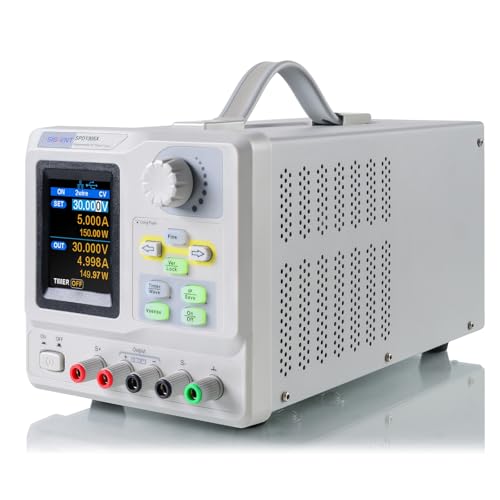
The SPD1305X is the pick for benches that treat the power supply as test equipment rather than an accessory. Its listing describes a programmable linear supply with a 2.8 inch TFT-LCD display, real-time waveform display and a 4-wire sense function that compensates for voltage drop in long test leads. Resolution is listed at 1 mV, the finest in this group, and the listing notes remote computer control capability, which suits automated test setups. Output covers the same 0 to 30 V and 0 to 5 A range as the other picks, at up to 150 W.
Specs
- Model: SPD1305X
- Channels: 1
- Output: 0-30 V, 0-5 A, up to 150 W
- Design: programmable linear DC power supply, as listed
- Display: 2.8 inch TFT-LCD
- Resolution: 1 mV, as listed
- Sense: 4-wire sense function, as listed
- Display feature: real-time waveform display, as listed
- Control: remote computer control capability, as listed
Best for: automated test benches and precision work that needs remote sense and fine resolution.
Watch out for: it is a single channel, and it costs more than the Korad units while covering the same output range, so the premium only pays off if you use the programmability.
ASIN: B07Q6FDZRF
KORAD KA3005D

The KA3005D is the most complete of the Korad digital line for a single-bench engineer. The listing describes a heavy duty single-channel linear supply with a 4-digit LED display that reads voltage, current and power, four memory locations for stored settings, and built-in over-voltage and over-current protection settings. A rotary encoder sets values with 10 mV and 1 mA setup resolution, ripple is listed at 2 mVrms or less, and a dedicated output on/off button plus a panel lock suit shared benches where settings should not drift.
Specs
- Model: KA3005D
- Output voltage: 0-30 V DC
- Output current: 0-5 A
- Output wattage: 150 W
- Display: 4-digit LED showing voltage, current and power
- Setup resolution: 10 mV and 1 mA, as listed
- Ripple: 2 mVrms or less, as listed
- Memory: 4 locations (M1-M4)
- Protection: over-voltage and over-current settings, as listed
- Input: rear-panel switchable 110 V / 220 V, as listed
- Item weight: 10 lb, as listed
Best for: engineers who repeat the same test setups and want stored presets with a power readout.
Watch out for: this D model has no computer interface in its listing; the programmable KA3005P is a separate listing, and the cooling fan runs under load.
ASIN: B0084JFWNY
Rigol DP711
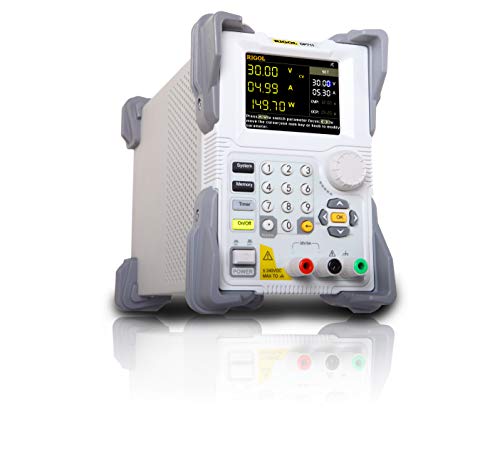
The DP711 is Rigol’s single-channel entry in the DP700 series, and its listing presents it as a programmable linear DC power supply rated at 30 V, 5 A and 150 W maximum. It is the heaviest unit in this guide at 6.61 kg as listed, which reflects the transformer-based design, and it carries a three year warranty on the main unit as listed. For engineers who already run Rigol instruments, it keeps the bench in one instrument family with a programmable interface for scripted testing.
Specs
- Model: DP711
- Output voltage: 30 V DC
- Output current: 5 A
- Maximum power: 150 W
- Design: programmable linear DC power supply, as listed
- Item weight: 6.61 kg, as listed
- Item dimensions: 13.06 x 7.95 x 5.51 inches, as listed
- Warranty: 3 years for the main unit and 1 year for accessories, as listed
Best for: benches that standardise on Rigol instruments and want warranty-backed programmable control.
Watch out for: it is the heaviest pick here and still a single channel, so dual-rail work needs a second supply alongside it.
ASIN: B01H7ANBS8
Tekpower TP3005T

The TP3005T is the straightforward option: a variable linear DC supply with two operational modes, constant voltage and constant current, and a back-lit LED display. The listing gives display resolution of 0.1 V and 0.01 A, a cooling fan that switches on automatically through a built-in thermo-sensor, and alligator test leads in the box. There are no memory presets or computer interface in the listing, which keeps the front panel simple for repair work, board bring-up and everyday prototyping where settings are dialed in by hand each time.
Specs
- Model: TP3005T
- Output: 0-30 V and 0-5 A
- Modes: constant voltage and constant current
- Display: back-lit LED with 0.1 V and 0.01 A resolution, as listed
- Cooling: fan with automatic thermo-sensor activation, as listed
- Included: alligator test leads, as listed
- Dimensions: 11.7 x 9.7 x 7.9 inches, as listed
- Warranty: 1 year manufacturer warranty, as listed
Best for: repair and service benches that want simple, clean linear power with leads included.
Watch out for: the 0.1 V display resolution is the coarsest here, so confirming a rail sits inside a tight tolerance band means reaching for a separate meter.
ASIN: B00ZBCLJSY
KORAD KD3005D

The KD3005D is Korad’s basic digital linear supply, built around the same 0 to 30 V and 0 to 5 A output as its KA-series sibling. The listing describes a heavy duty single-channel linear design with a bright 4-digit LED screen showing voltage and current values. What it leaves out is just as clear from the listing: there is no power readout, no memory storage and no computer interface, so it suits a bench that needs clean linear power and a clear display without paying for programmability.
Specs
- Model: KD3005D
- Output range: 0-30 V
- Current range: 0-5 A
- Design: single-channel linear power supply, as listed
- Display: 4-digit LED screen for voltage and current values
- Form factor: benchtop
Best for: a first linear bench supply, or a second unit for general prototyping and coursework.
Watch out for: with no power readout, memory or interface in the listing, it cannot join scripted tests, and wattage has to be worked out from the two readouts.
ASIN: B00FPU6G4E
Which One Fits Your Situation
You prototype audio, sensor or RF circuits
Pick the Siglent SPD1305X. Its listing pairs a 1 mV resolution with a 4-wire sense function and a real-time waveform display, so you can hold a rail steady at the board and watch it behave over time. The programmable interface also means the supply can sit inside a scripted noise or load test instead of being adjusted by hand.
You run repeated tests on a production or teaching bench
Choose the Korad KA3005D. Four memory locations store the voltage and current settings your routine uses most, the panel lock stops casual changes between sessions, and the output on/off button keeps connections safe while boards are swapped. Ripple listed at 2 mVrms or less keeps the output clean enough for mixed analog and digital work.
You need one dependable brand-name instrument
The Rigol DP711 fits benches that standardise on a single instrument maker or need warranty support behind the purchase. Its listing shows a three year warranty on the main unit, a programmable linear output at 30 V and 5 A, and a solid 6.61 kg chassis. It gives up the Korad’s memory presets, so weigh scripted control against stored settings.
You want simple, low-cost linear power for repairs
Take the Tekpower TP3005T or the Korad KD3005D. Both cover 0 to 30 V and 0 to 5 A with a clear LED display and no menus to learn. The Tekpower includes alligator test leads and a thermo-sensor fan; the KD3005D adds finer 4-digit readouts of voltage and current. Either suits a repair bench that values clean output over programmability.
Common Mistakes
- Buying a switching supply for noise-sensitive work: many inexpensive bench supplies are switching designs, and their high-frequency noise can swamp audio and RF measurements even when the voltage and current ratings look identical on paper.
- Ignoring display resolution: a supply that only reads to 0.1 V cannot confirm a rail is inside a tight tolerance band, no matter how stable its output stage is.
- Leaving the output live while connecting leads: use the output on/off button where the listing provides one, and set the current limit before connecting a board you have not powered before.
- Blocking the vents of a linear supply: linear designs turn excess voltage into heat, so a unit run near full current needs clear airflow around its case and fan.
- Assuming sibling models match: the Korad D and P variants differ in interface and memory, so confirm the exact model code on the listing rather than ordering by the headline rating alone.
Frequently Asked Questions
Why choose a linear bench supply over a switching one?
A linear supply regulates output with a transformer and a pass element, so it produces very little high-frequency noise and suits audio, RF and precision analog work. A switching supply is lighter and more efficient, but its switching noise can appear in sensitive measurements. Choose linear when the cleanliness of the rail matters more than weight or efficiency.
What does ripple mean on a power supply specification?
Ripple is the small AC variation left on top of the DC output. Listings quote it in millivolts RMS over a stated bandwidth; the Korad KA3005D, for example, lists 2 mVrms or less. Lower ripple means a cleaner rail for measurement and audio circuits. A listing that prints no ripple figure gives you no basis for comparing noise performance.
Is 30 V and 5 A enough for an engineering workbench?
For most prototyping it is. Logic boards, microcontrollers, op-amp circuits, sensors and small actuators nearly all run below 30 V, and 5 A covers several boards at once or a single hungry load. Work with high-voltage rails, large motors or battery packs may need a second, higher-rated supply, but 30 V and 5 A is the standard starting point for electronics benches.
Can I use a bench power supply to charge a battery?
A bench supply is not a battery charger. Its constant-voltage and constant-current modes can limit voltage and current, but it has no charge termination, temperature monitoring or chemistry-specific profile, and a linear supply will also dissipate the difference as heat. Use a dedicated charger for routine charging, and reserve the bench supply for powering and testing the device itself.
More from Amazon
Programs that pair well with the guide above. Offers and eligibility are set by Amazon and may change.
Free shipping on eligible items, Prime Video and more. Eligible new members can start with a free trial.
Start a Prime free trialAudiobooks and podcasts to listen to on the go. Eligible new members can start with a free trial.
Try Audible freeAd-free music streaming. Eligible new subscribers can start with a free trial.
Try Music Unlimited freeA free business account with business pricing and bulk-buying tools for work, shop or home office.
Create a business accountAs an Amazon Associate we earn from qualifying purchases.







Write Your Review
No reviews yet. Be the first to share your experience!