
Our Short List of 3

- Best for: Turners who want the largest midi capacity and a very slow starting speed for bowls and long spindles.
- Specs: 1 HP motor, 115 volts
- Specs: 12 inch swing over bed, 21 inches between centers
- Specs: Three speed ranges of 60 to 900, 110 to 1800, and 220 to 3600 RPM
- Specs: Cast iron and steel construction, 121 pounds
- Best for: Small-shop turners who want JET build quality, dial speed control, and indexing for decorative projects.
- Specs: 1/2 HP motor, 115 volts, 3.2 amps
- Specs: 10 inch swing over bed, 15-1/2 inches between centers
- Specs: Three speed ranges of 200 to 1050, 300 to 1750, and 600 to 3600 RPM
- Specs: 24-position indexing

- Best for: Turners who want the widest swing in a midi frame plus reverse rotation for cleaner sanding and finishing.
- Specs: 1 HP motor, 1725 RPM
- Specs: 12-1/2 inch swing over bed, 16-1/2 inches between centers
- Specs: Speed ranges of 250 to 700, 600 to 1800, and 1350 to 4000 RPM
- Specs: Forward and reverse rotation
All 5 Picks at a Glance
| Product | Specs | Action |
|---|---|---|
| 1. JET JWL-1221VS |
| Check price on Amazon |
| 2. JET JWL-1015VS |
| Check price on Amazon |
| 3. Delta 46-460 |
| Check price on Amazon |
 4. NOVA Comet II 46300 |
| Check price on Amazon |
 5. WEN LA3421 |
| Check price on Amazon |
Key takeaways
- Compare the 5 best midi wood lathes with variable speed controls for pens, spindles and small bowls, with specs to help you choose the right bench lathe.
A midi wood lathe sits in a useful middle ground between a small pen lathe and a full-size floor machine. It fits on a sturdy bench, turns spindles and small bowls with confidence, and still leaves room in a compact workshop for other tools. Variable speed control is what makes that middle ground work so well, because one blank may need a slow, careful start while another needs a fast, clean finishing pass.
The five lathes below all offer a dial or electronic control for changing speed without stopping to move a belt between every cut. They differ in swing, distance between centers, motor size, and the lowest speed they can hold, so the right choice depends on what you plan to turn most often. Use the guide that follows to match capacity and control style to your bench, your projects, and the way you like to work.
Quick Picks
As an Amazon Associate we earn from qualifying purchases
| Product | Best for | Key spec from title |
|---|---|---|
| JET JWL-1221VS | Largest turning capacity | 12 x 21 inch capacity, 60 to 3600 RPM |
| JET JWL-1015VS | Detailed work and indexing | 10 x 15 inch capacity, 200 to 3600 RPM |
| Delta 46-460 | Bowls and reversing cuts | 12-1/2 inch swing, 250 to 4000 RPM |
| NOVA Comet II 46300 | Portable midi turning | 12 x 16-1/2 inch capacity, 250 to 4000 RPM |
| WEN LA3421 | Beginners and small pens | 8 x 13 inch capacity, 750 to 3200 RPM |
How to Choose
Match the Swing and Length to Your Projects
Swing over the bed sets the largest diameter you can turn, while distance between centers sets the longest spindle you can mount. A 12 inch swing handles small bowls and platters that an 8 inch machine cannot, and a 21 inch center distance suits table legs, rolling pins, and long handles. Measure the blanks you already own and the finished pieces you want to make, then add a little headroom so the lathe does not limit your next project. Pens and bottle stoppers need far less capacity than bowls, so a compact lathe can be the smarter buy when small work is your main focus.
Look at the Low End of the Speed Range
Top speed gets plenty of attention, yet the lowest speed often matters more in daily use. Roughing an out-of-balance bowl blank at high speed can shake the bench and throw the work off center, while a slow start near 60 or 250 RPM lets you shape the blank into round before speeding up. Sanding and finishing also benefit from a gentle pace that keeps friction low and the surface smooth. If you plan to turn bowls from rough blanks, favor a lathe that can hold a genuinely slow speed under load rather than one that only advertises a high maximum.
Check How the Speed Control Actually Works
Some midi lathes offer a true electronic dial that changes speed while the spindle is turning, while others combine a dial with belt positions that set a broad range. A dial-only design is the most convenient, because you can slow down for a catch-prone cut and speed up for a finishing pass without reaching inside the headstock. A dial plus belt ranges still works well and often gives stronger torque at low speed, but it asks for a short pause when you move between ranges. Read the listed speed ranges closely, and confirm that the control knob, switch, and readout sit where you can reach them safely while turning.
Weigh the Motor, Weight, and Bench Space
Motor size shapes how the lathe behaves when a gouge bites into hard wood, and a heavier cast iron bed helps absorb vibration before it reaches the cutting edge. A 1 HP motor with a solid bed suits frequent bowl work and dense hardwoods, while a smaller motor is enough for pens, spindles, and softwood if you take light cuts. Weight is a trade-off, because a heavy lathe stays put during roughing but is harder to move or store. Before ordering, measure your bench, check the lathe footprint, and make sure the bench can carry the machine without flexing.
The 5 Best Options
1. JET JWL-1221VS
- Best for: Turners who want the largest midi capacity and a very slow starting speed for bowls and long spindles.
- Specs: 1 HP motor, 115 volts
- Specs: 12 inch swing over bed, 21 inches between centers
- Specs: Three speed ranges of 60 to 900, 110 to 1800, and 220 to 3600 RPM
- Specs: Cast iron and steel construction, 121 pounds
Turners who want the largest midi capacity and a very slow starting speed for bowls and long spindles.
Its weight and footprint demand a strong, level bench, and you will need help moving it into place.
The JET JWL-1221VS leads this group on capacity and low-speed control, pairing a 12 inch swing with 21 inches between centers and a speed range that drops to 60 RPM. That slow bottom end is a real advantage when roughing a bowl blank that is still square or uneven, and the three ranges carry the spindle up to 3600 RPM for fine finishing. Its cast iron and steel build keeps vibration low, and the ratchet-style belt tension system makes range changes quicker than fumbling with a loose belt and a wrench.
Watch out for: Its weight and footprint demand a strong, level bench, and you will need help moving it into place.
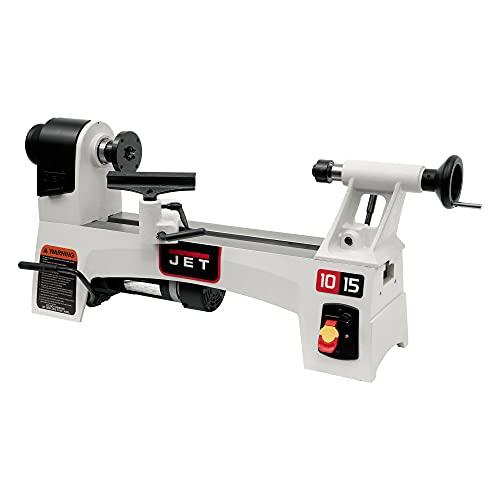
2. JET JWL-1015VS
- Best for: Small-shop turners who want JET build quality, dial speed control, and indexing for decorative projects.
- Specs: 1/2 HP motor, 115 volts, 3.2 amps
- Specs: 10 inch swing over bed, 15-1/2 inches between centers
- Specs: Three speed ranges of 200 to 1050, 300 to 1750, and 600 to 3600 RPM
- Specs: 24-position indexing
Small-shop turners who want JET build quality, dial speed control, and indexing for decorative projects.
The smaller swing and shorter bed rule out larger bowls and long spindles, so check your project sizes first.
The JET JWL-1015VS is the compact sibling in this lineup, with a 10 inch swing and 15 inches between centers in a bench-friendly frame. Its electronic dial fine-tunes speed inside three belt-selected ranges, so you can rough a small bowl blank at a gentle pace and then lift the speed for a smooth finishing cut. The 24-position indexing head is a useful bonus for fluting, drilling evenly spaced holes, and other decorative work that needs repeatable spacing around the piece.
Watch out for: The smaller swing and shorter bed rule out larger bowls and long spindles, so check your project sizes first.
3. Delta 46-460
- Best for: Turners who want the widest swing in a midi frame plus reverse rotation for cleaner sanding and finishing.
- Specs: 1 HP motor, 1725 RPM
- Specs: 12-1/2 inch swing over bed, 16-1/2 inches between centers
- Specs: Speed ranges of 250 to 700, 600 to 1800, and 1350 to 4000 RPM
- Specs: Forward and reverse rotation
Turners who want the widest swing in a midi frame plus reverse rotation for cleaner sanding and finishing.
Speed changes still involve pulley positions, so allow a short pause when you move between ranges.
The Delta 46-460 has long been a familiar name in midi turning, and its 12-1/2 inch swing is the widest in this group. A 1 HP motor drives the spindle through three pulley speed ranges with electronic variable speed adjustment inside each range, giving a broad spread from 250 up to 4000 RPM. Forward and reverse rotation helps with sanding and finishing, because reversing the direction can smooth fibers that lie flat in one direction and lift in the other. Two tool rests and a faceplate come in the box, so you can start on spindles or faceplate work without buying extra parts at once.
Watch out for: Speed changes still involve pulley positions, so allow a short pause when you move between ranges.
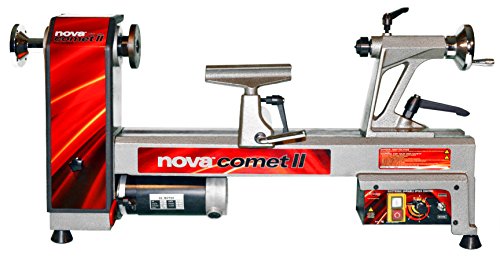
4. NOVA Comet II 46300
- Best for: Turners who want a portable midi lathe with a wide speed range and the option to extend the bed later.
- Specs: 3/4 HP electronic variable speed motor
- Specs: 12 inch swing over bed, 16-1/2 inches between centers
- Specs: Speed range of 250 to 4000 RPM across three belt ranges
- Specs: Forward and reverse switch
Turners who want a portable midi lathe with a wide speed range and the option to extend the bed later.
The included tool rest is on the short side for longer spindles, so a longer rest may be worth adding.
The NOVA Comet II 46300 is built around portability and a wide electronic speed range, running from 250 up to 4000 RPM on a 3/4 HP motor. Its 12 inch swing and 16-1/2 inches between centers cover pens, spindles, and small bowls, and the bed can be extended to 41 inches for longer work when you add the optional bed extension accessory. Forward and reverse switching adds flexibility for sanding, and the compact cast iron frame suits a bench that must serve more than one purpose.
Watch out for: The included tool rest is on the short side for longer spindles, so a longer rest may be worth adding.
5. WEN LA3421
- Best for: Beginners and pen turners who want simple dial speed control in a light, compact benchtop lathe.
- Specs: 3.2-amp motor with soft start
- Specs: 8 inch swing over bed, 13 inches between centers
- Specs: Variable speed from 750 to 3200 RPM
- Specs: 2.3-inch faceplate included
Beginners and pen turners who want simple dial speed control in a light, compact benchtop lathe.
The 750 RPM minimum is too fast for roughing a large, uneven blank, and the MT1 taper limits accessory choices.
The WEN LA3421 is the smallest and simplest lathe here, and that is exactly its appeal for a first midi lathe. An 8 inch swing and 13 inches between centers suit pens, small bowls, chess pieces, and other compact projects, while the variable speed dial adjusts anywhere from 750 to 3200 RPM without belt changes. A soft-start motor eases the spindle up to speed instead of jerking the blank, and the two included tool rests cover short and medium work. At 45.9 pounds it is also the easiest machine in this group to lift on and off a bench.
Watch out for: The 750 RPM minimum is too fast for roughing a large, uneven blank, and the MT1 taper limits accessory choices.
Which One Fits Your Situation
You Turn Pens and Small Gifts Most of the Time
Choose the WEN LA3421 when pens, bottle stoppers, small bowls, and gift pieces fill most of your turning sessions. Its compact bed fits a crowded bench, the dial gives you speed control without belt changes, and the light weight makes storage simple. You give up low-speed roughing and large capacity, but for small, balanced blanks that trade-off rarely matters.
You Want One Lathe for Bowls and Spindles
Choose the JET JWL-1221VS when you want a single midi lathe that can handle both long spindles and small bowls. Its 21 inch center distance and 60 RPM low speed cover the two jobs that smaller lathes struggle with, while the 1 HP motor keeps cuts steady in denser wood. It needs a strong bench and a permanent spot, so plan the space before it arrives.
You Value Reverse and a Wide Swing on a Budget Frame
Choose the Delta 46-460 when a wide swing and reverse rotation matter more to you than a fully electronic dial. The 12-1/2 inch swing opens up bowl sizes that other midi lathes cannot reach, and reverse helps during sanding and finishing. The pulley ranges ask for a little patience, but the capacity and motor size reward that extra step.
You Need a Lathe You Can Move or Store
Choose the NOVA Comet II 46300 when bench space is shared or the lathe must travel to a class, a club night, or a second workspace. Its compact cast iron frame and wide 250 to 4000 RPM range handle a broad mix of projects, and the optional bed extension keeps longer spindles possible later. It is a practical pick when portability matters as much as turning capacity.
Common Mistakes
- Buying for top speed alone and ignoring the low end, which is what keeps rough bowl blanks under control.
- Choosing a swing that is too small for the bowls you want to turn, then trying to force oversize blanks onto the lathe.
- Setting a heavy lathe on a light or wobbly bench, which lets vibration reach the tool and spoil the surface.
- Skipping the tailstock and tool rest setup, then wondering why spindles taper or chatter appears mid-cut.
- Turning at finishing speed while the blank is still square, instead of rounding it at a slow speed first.
Frequently Asked Questions
What size midi lathe do I need for small bowls?
A 10 to 12 inch swing covers most small bowls, because swing sets the largest diameter the lathe can turn over the bed. An 8 inch machine suits pens and tiny bowls, while a 12 inch swing leaves room for salad bowls and shallow platters. Check the blank diameter before you buy, and leave a little clearance so the blank spins freely.
Is electronic variable speed better than belt speeds?
Electronic variable speed is more convenient, because you turn a dial while the spindle runs instead of stopping to move a belt. Belt ranges still work well and often hold torque better at very low speed, so a dial plus belt design can be a sound compromise. The best choice is the control style you will actually use for every speed change.
Can a midi lathe turn table legs?
Yes, when the distance between centers is long enough for the leg plus the drive and tailstock centers. A 21 inch capacity handles many table legs, while a 16-1/2 inch lathe suits shorter legs, candlesticks, and rolling pins. For longer legs, look for a model with an optional bed extension that adds useful length.
Do I need reverse rotation on a midi lathe?
Reverse is helpful but not essential, because it lets you sand against the grain direction and smooth fibers that a single direction leaves raised. Many turners manage fine without it by changing sandpaper grits and sanding with care. If you finish a lot of bowls, reverse is worth having; for pens and spindles, it matters far less.
More from Amazon
Programs that pair well with the guide above. Offers and eligibility are set by Amazon and may change.
Free shipping on eligible items, Prime Video and more. Eligible new members can start with a free trial.
Start a Prime free trialAudiobooks and podcasts to listen to on the go. Eligible new members can start with a free trial.
Try Audible freeAd-free music streaming. Eligible new subscribers can start with a free trial.
Try Music Unlimited freeA free business account with business pricing and bulk-buying tools for work, shop or home office.
Create a business accountAs an Amazon Associate we earn from qualifying purchases.

Write Your Review
No reviews yet. Be the first to share your experience!