

Key takeaways
- Compare five linear bench power supplies with overvoltage protection, from 30V 5A bench units to a 10A workhorse and a precise Siglent for analog work.
A bench power supply sits between the wall socket and a circuit you built by hand, so the real decision is how much damage a slip can do. A linear supply keeps switching noise out of sensitive analog stages, and overvoltage protection puts a ceiling on the output: if the voltage climbs past the limit, the supply cuts it off instead of feeding the excess into your board.


This guide is for hobbyists, repair benches, students, and small home labs that power microcontrollers, audio stages, sensors, and motor drivers. Every model below is a linear regulated bench supply with overvoltage protection shown on its Amazon listing page, chosen from the output range, protection controls, and display details on the listing.
Quick Picks
As an Amazon Associate we earn from qualifying purchases.
| Product | Best for | Key spec |
|---|---|---|
| Korad KA3005D | First linear supply for microcontroller boards | 0-30 V, 0-5 A linear output |
| Korad KA3005P | Repetitive bench work with PC control | 0-30 V, 0-5 A, USB and RS232 |
| Korad KA3010D | Higher-current loads up to 10 A | 0-30 V, 0-10 A, 300 W output |
| Korad KA3010P | Automated 10 A work with PC control | 0-30 V, 0-10 A, USB and RS232 |
| Siglent SPD1305X | Precise analog work with remote sensing | 0-30 V, 0-5 A, 1 mV resolution |
How to Choose
Match the voltage and current to the load
Most microcontroller boards, sensors, and small modules draw well under 5 A, so a 30 V, 5 A supply covers a large share of bench work, including 5 V logic, 12 V peripherals, and 24 V industrial parts. Step up to a 10 A model when the load includes motors, long LED runs, heaters, or boards with large inrush current at switch-on. Check the peak draw of the load, not only its steady draw, because a supply that trips into current limiting at every switch-on makes the bench frustrating to use. Leave headroom above the highest draw you expect.
Decide how the overvoltage protection should work
Overvoltage protection is not one identical feature across these models. The Korad KA models let you set the trip point from the front panel, so you can dial in a ceiling just above the voltage your board needs and the supply cuts the output when that ceiling is crossed. The Siglent SPD1305X instead uses built-in protection that trips at a fixed level above the normal output range, which guards against internal faults rather than a wrong knob setting. Settable protection suits benches that power many different boards, while fixed protection suits a bench that runs one voltage family day after day.
Read the display and resolution you actually need
A 4-digit LED display with 10 mV and 1 mA setting resolution is enough for most repair and hobby work, where the goal is a stable 5 V, 12 V, or 24 V rail. The Siglent SPD1305X moves to 1 mV and 1 mA resolution with a color TFT-LCD display and a real-time waveform view, which helps when you are trimming a low-voltage reference, checking a regulator under load, or watching a rail sag during a transient. Finer resolution is worth having when the circuit under test is sensitive to small voltage changes, and it is unnecessary weight when the bench only feeds logic boards.
Weigh programmability against simplicity
The P models from Korad and the Siglent carry USB and RS232 interfaces, and the Siglent adds LAN, so a computer can set voltages, log readings, and run the same sequence again without touching a knob. Memory recall buttons on the front panel give a middle ground: store a few common setups and jump between them with one press. The plain D models skip the computer link entirely and keep the bench simple, with knobs, buttons, and a display. Choose the programmable route when the same procedure repeats often, and choose the simple route when the bench is used for one-off repairs.
The 5 Best Options
Korad KA3005D
The KA3005D is the straightforward way onto a linear bench: a single-channel 30 V, 5 A supply with settable overvoltage protection, a clear 4-digit LED display, and coarse plus fine controls for voltage and current. It suits a first bench supply for microcontroller boards, sensor rigs, and small repair jobs, where the priority is a clean output and a hard ceiling on voltage rather than computer control. Memory recall stores favorite settings so a common 5 V or 12 V rail is one press away, and the switchable input works on either common mains voltage.
Specs
- Output: 0-30 V, 0-5 A, single channel, linear regulation
- Protection: built-in over-current and voltage protection with front-panel controls
- Display: 4-digit LED for voltage and current
- Setup resolution: 10 mV / 1 mA
- Memory recall for stored settings
- Input: switchable 110/220 V
Best for: A first linear bench supply for microcontroller boards and repair work.
Watch out for: No USB or RS232 interface, so automated setups need the P model instead.
Korad KA3005P
The KA3005P takes the same 30 V, 5 A linear output and adds the features that matter when the same bench procedure repeats: four memory locations, an output on/off button, a rotary encoder for fine adjustment, and USB plus RS232 for PC control. The listing states built-in over-current and voltage protection settings, and the low ripple figure keeps the output quiet enough for analog stages and audio circuits. A panel lock guards against accidental changes during long runs, and the bright 4-digit LED display stays legible from across the bench.
Specs
- Output: 0-30 V, 0-5 A, single channel, linear regulation
- Protection: built-in over-current and voltage protection settings
- Display: 4-digit LED, 10 mV / 1 mA setup resolution
- Ripple: 2 mVrms or less
- Interfaces: USB and RS232 for PC control
- Memory: four locations (M1-M4) for stored settings
- Output on/off button, rotary encoder, and panel lock
- Input: switchable 110/220 V
- Weight: 9.52 lb; dimensions: 100 x 156 x 260 mm
Best for: Repetitive bench work, production checks, and PC-controlled setups.
Watch out for: The PC software is basic, so confirm it covers your control needs before building a rig around it.
Korad KA3010D

The KA3010D doubles the current of the 5 A models, reaching 0-10 A at up to 30 V for a 300 W maximum output, while keeping the same linear regulation and settable overvoltage protection. That extra current suits motors, long LED runs, and boards that pull hard at switch-on, and the memory presets plus constant-voltage and constant-current operation keep the workflow familiar to anyone who has used a Korad bench supply. The unit is larger and heavier than the 5 A models, which is the normal trade for a bigger transformer and more output headroom.
Specs
- Output: 0-30 V, 0-10 A, 300 W maximum output, single channel, linear regulation
- Protection: built-in over-voltage and over-current protection
- Display: 4-digit LED, 10 mV / 1 mA setup resolution
- Memory presets and constant-voltage / constant-current operation
- Input: switchable 110/220 V
- Includes 10 A leads
Best for: Motors, LED runs, and other higher-current loads on a linear supply.
Watch out for: The larger case needs more bench space, and the area around it should stay clear for airflow.
Korad KA3010P

The KA3010P pairs the 10 A output with the full programmable feature set: USB and RS232 for PC control, four memory locations, and front-panel overvoltage and overcurrent indicators with their own buttons. It is the model to pick when the load needs real current and the procedure needs repeating, such as burn-in runs, batch programming of boards, or endurance checks on motors and drivers. The settable overvoltage protection matters more here than on a 5 A unit, because a 10 A supply can deliver a damaging fault current before a fuse or a board trace reacts.
Specs
- Output: 0-30 V, 0-10 A, single channel, linear regulation
- Protection: built-in over-current and over-voltage protection with front-panel indicators and buttons
- Display: 4-digit LED, 10 mV / 1 mA setup resolution
- Interfaces: USB and RS232 for PC control
- Memory: four locations (M1-M4) for stored settings
- Input: switchable 110/220 V
Best for: Automated 10 A work such as batch board checks and endurance runs.
Watch out for: Plan the wiring for 10 A; thin hookup wire and small clips are not the right match for this output.
Siglent SPD1305X
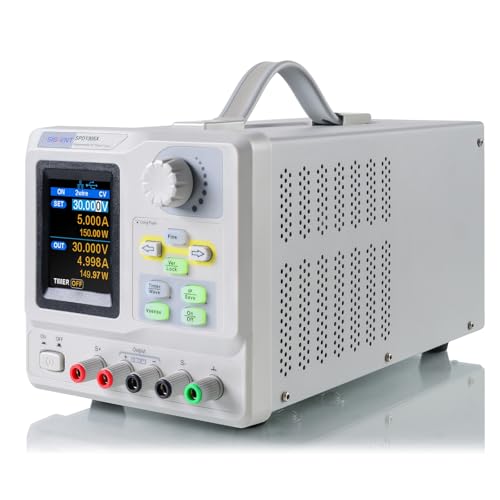
The SPD1305X is the precision pick in this group: a single-channel programmable linear supply with a 2.8-inch TFT-LCD display, a real-time waveform view, and 1 mV and 1 mA resolution that makes fine trimming straightforward. Its 4-wire sense mode compensates for voltage drop in long leads, which matters when the board sits away from the supply or the leads carry real current. Built-in overvoltage, overcurrent, overtemperature, and short-circuit protection cover the safety side, and USB, RS232, and LAN give more ways to connect it to a computer than any other model here.
Specs
- Output: 0-30 V, 0-5 A, 150 W maximum output, single channel, linear regulation
- Protection: built-in overvoltage, overcurrent, overtemperature, and short-circuit protection
- Display: 2.8-inch TFT-LCD with real-time waveform display
- Resolution: 1 mV / 1 mA
- Ripple and noise: 350 uVrms or less and 3 mVpp or less
- 4-wire sense compensation up to 1 V
- Interfaces: USB, RS232, and LAN
- Save and recall memory
Best for: Low-noise analog, audio, and measurement work that needs fine resolution.
Watch out for: The overvoltage protection trips at a fixed level above the normal output range rather than a user-set ceiling, so set the output carefully for low-voltage boards.
Which One Fits Your Situation
First bench supply for a home electronics bench
Pick the Korad KA3005D. A 30 V, 5 A linear output with settable overvoltage protection covers microcontroller boards, sensors, and small repairs, and the front-panel controls are easy to learn. There is no computer link to set up, and the memory recall keeps common rails one press away. Settable overvoltage protection is the safety net that makes it forgiving while you learn.
Repetitive work and automated setups
Pick the Korad KA3005P for 5 A work or the KA3010P when the load needs 10 A. Both store four setups, connect over USB and RS232, and let you repeat the same sequence without touching a knob each time. The panel lock keeps a long run safe from accidental changes.
Powering motors, LED strips, and other hungry loads
Pick the Korad KA3010D. Its 10 A output and 300 W ceiling handle inrush current and sustained draw that would push a 5 A supply into current limiting. The settable overvoltage protection still guards the load, and the included 10 A leads match the output. The memory presets keep common voltages close at hand when the load changes between jobs.
Low-noise analog, audio, and measurement work
Pick the Siglent SPD1305X. The 1 mV resolution, the quiet output, and the 4-wire sense mode suit analog stages, audio circuits, and regulator checks where small voltage errors matter. The waveform display shows what the rail is doing under load. Settable protection is not available here, so double-check the output setting before connecting a low-voltage board.
Common Mistakes
- Buying a switching supply when the work needs the quiet output of a linear supply.
- Assuming every bench supply has overvoltage protection; check that the listing states it.
- Sizing the supply to the average draw instead of the peak draw, then hitting current limiting at switch-on.
- Using thin wire and small clips on a 10 A output instead of leads built for the current.
- Connecting the load first and then setting the voltage with the output live; set the voltage, then enable the output.
Frequently Asked Questions
What does overvoltage protection do on a bench power supply?
Overvoltage protection cuts the output when the voltage passes a limit, so a fault or a wrong setting cannot feed excess voltage into the board under test. On the Korad models here the limit is set from the front panel; on the Siglent it trips at a fixed level above the normal range. Either way, the board sees no voltage above the limit.
Is a linear bench supply better than a switching one?
A linear supply gives a quieter output with less ripple and noise, which matters for analog, audio, and measurement work. A switching supply is lighter and more efficient and delivers more watts per dollar, so it suits charging, motors, and high-power loads. The right choice follows the load: quiet work favors linear, raw power favors switching.
Do I need 10 A, or is 5 A enough?
Most microcontroller boards, sensors, and small modules draw well under 5 A, so a 30 V, 5 A supply covers them with room to spare. Move to 10 A when the load includes motors, long LED runs, heaters, or boards with a large inrush current at switch-on. Check the peak draw, not only the steady draw, before deciding.
Can I control these supplies from a computer?
The Korad KA3005P and KA3010P connect over USB and RS232, and the Siglent SPD1305X adds LAN to USB and RS232. The Korad KA3005D and KA3010D have no computer interface and are set entirely from the front panel. Memory recall on all five models stores common setups for quick reuse without a computer.
More from Amazon
Programs that pair well with the guide above. Offers and eligibility are set by Amazon and may change.
Free shipping on eligible items, Prime Video and more. Eligible new members can start with a free trial.
Start a Prime free trialAudiobooks and podcasts to listen to on the go. Eligible new members can start with a free trial.
Try Audible freeAd-free music streaming. Eligible new subscribers can start with a free trial.
Try Music Unlimited freeA free business account with business pricing and bulk-buying tools for work, shop or home office.
Create a business accountAs an Amazon Associate we earn from qualifying purchases.
Write Your Review
No reviews yet. Be the first to share your experience!