
Key takeaways
- The best dual drum sanders with variable conveyor speeds run two grits in one pass. Compare the SuperMax 25x2 and Shop Fox W1678 on width, feed and power.
A dual drum sander runs two abrasive drums in sequence over the same board. The front drum usually carries a coarser grit that does most of the material removal, and the rear drum carries a finer grit that cleans up the surface, so a panel comes out flatter and smoother in a single pass than a single-drum machine can manage without an abrasive change in between. The conveyor is what makes or breaks that arrangement. Feed the work too quickly and the drums overload, stall, or leave chatter marks; feed it too slowly and friction builds heat that can glaze the abrasive and scorch the wood. A variable conveyor speed lets you match the feed rate to the species, the width of the panel, and the grit on the drums, which is why it is the feature that separates a frustrating drum sander from a productive one.
This guide is for cabinet shops, furniture makers, and serious home woodworkers who flatten wide glue-ups, doors, and tabletop panels and want that control over feed rate. Only machines that meet both halves of the brief are included: two drums, and a variable-speed conveyor. Every product below is a dual drum sander sold on Amazon US, and the specifications are taken from the Amazon listing details for each model. Only two machines currently meet both criteria with confirmed listings, so this is a short list by design rather than a padded one. If neither fits your shop, the honest answer is to widen the search offline rather than settle for a single-drum machine that does a different job.
Quick Picks
| Product | Best for | Key spec |
|---|---|---|
| SuperMax Tools 25×2 Double Drum Sander (SUPMX-913002) | Load-sensing feed control | 25 in width, SandSmart variable conveyor |
| Shop Fox W1678 5 HP 26-Inch Dual Drum Sander | Maximum width and manual control | 26 in width, variable feed up to 20 FPM |
How to Choose
Variable conveyor speed and load sensing
The feed rate decides how much work each drum does on every revolution. A wide maple glue-up at a coarse grit loads the drums far harder than a narrow pine board at a fine grit, and a fixed-speed conveyor forces you to compromise between the two. Variable speed lets you slow the belt for wide, dense, or figured stock and for final passes, then speed it up when you are doing lighter cleanup work. The most advanced version of this idea is load sensing: the SuperMax in this guide uses its INTELLISAND and SandSmart system to monitor the load on the drums and adjust the conveyor speed automatically, slowing the feed when the cut gets heavy instead of letting the motor bog down or the abrasive burn the surface. The Shop Fox takes the manual route, with a variable feed rate of up to 20 FPM that you set yourself. Automatic sensing is more forgiving for mixed workloads; a manual dial is simpler and gives an experienced operator direct, repeatable control.
Sanding width and drum arrangement
Width decides which panels you can finish in one pass. The two machines here sand 25 in and 26 in respectively, which covers most cabinet doors, drawer banks, and tabletop glue-ups without splitting the work. Think about the widest panel you realistically produce, not the widest you can imagine, because drum sanders grow quickly in footprint and cost as width climbs. Drum arrangement matters as much as width. With two drums you can run a coarse grit in front and a finer grit behind, which is the entire point of the format. A rear drum that can be fine-tuned for contact, like the micro-adjustable rear drum on the Shop Fox, lets you decide exactly how much of the finishing work the second drum does, which helps when you change grit combinations.
Motor power and shop wiring
Both machines in this guide run 5 HP motors, which is the right neighbourhood for sanding wide panels without the drums slowing under load. Power is only useful if your shop can supply it, though. The SuperMax is specified as a 1-phase, 220V machine, which suits shops wired for single-phase 220V service; confirm that your panel and circuit can carry a 5 HP load before ordering any machine in this class, and plan on a dedicated circuit. Drum speed also plays a part in how the abrasive cuts: the Shop Fox lists a drum speed of 2300 RPM. These are heavy, stationary machines, so check floor space, door widths, and how the sander will be positioned relative to your dust collector and outfeed area before committing.
Abrasives and dust collection
A drum sander converts solid wood into a surprising volume of fine dust, and it does so continuously, so dust collection is not an accessory but part of the machine. The Shop Fox addresses this with dual dust ports and a hood with internal baffles, which help pull dust from both drums instead of letting it pack around the rear drum. You will want a proper dust collector sized for a wide drum sander rather than a small shop vacuum. Abrasive handling is the other running cost. The Shop Fox uses hook-and-loop abrasive attachment, which makes changing wraps straightforward. Whichever machine you choose, keep the wraps clean with an abrasive cleaning stick, avoid feeding painted or glue-covered stock that loads the paper, and remember that a loaded wrap raises heat and ruins finishes long before it looks worn out.
The 2 Best Options
SuperMax Tools 25×2 Double Drum Sander (SUPMX-913002)
The SuperMax Tools 25×2 Double Drum Sander (SUPMX-913002) is a 25-inch double drum sander from the SuperMax line by Laguna Tools, and its defining feature is what happens at the conveyor. The variable-speed feed is governed by INTELLISAND with SandSmart load-sensing control, which watches the load on the drums and adjusts the feed rate to match. When a wide hardwood panel pushes the cut harder than expected, the conveyor slows down on its own rather than forcing the board through, which protects the motor, the abrasive, and the surface of the work.
That automation suits shops where the workload changes from board to board: one pass might be a narrow softwood panel and the next a full-width hardwood glue-up, and the machine adapts instead of needing a new feed setting each time. The 5 HP motor runs on 1-phase 220V power, which keeps it within reach of shops that do not have three-phase service. At 25 inches of sanding width it handles most cabinet and furniture panels in a single pass, with the two drums letting you run a coarse and a fine grit together.
- Specs:
- Brand: SuperMax Tools (Laguna Tools)
- Model Number: SUPMX-913002
- Sanding width: 25 in
- Drums: 2 (double drum)
- Conveyor: Variable speed with INTELLISAND / SandSmart load-sensing feed control
- Motor: 5 HP, 1-phase, 220V
- Best for: Shops that sand wide hardwood panels often and want load-sensing feed control that slows the conveyor automatically when the cut gets heavy.
- Watch out for: At 25 in it gives up an inch of width to the Shop Fox, and you need a 220V single-phase circuit with enough capacity for a 5 HP motor.
Shop Fox W1678 5 HP 26-Inch Dual Drum Sander
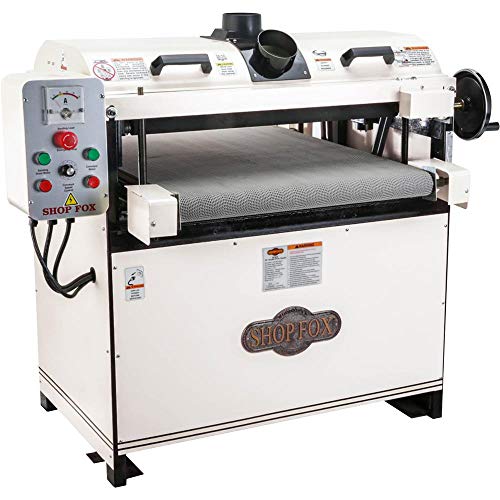
The Shop Fox W1678 5 HP 26-Inch Dual Drum Sander is the wider of the two machines here, with 26 inches of sanding capacity and a 5 HP motor turning the drums at 2300 RPM. Its conveyor provides a variable feed rate of up to 20 FPM, set manually, so you can creep the belt for a final pass with a fine grit on the rear drum or open it up when the front drum is doing rough work with a coarse grit. For operators who like to dial in a feed rate for a given species and repeat it all day, that direct control is a feature rather than a chore.
The detail that sets the W1678 apart is its micro-adjustable rear drum, which lets you fine-tune how firmly the finishing drum contacts the work when you change grit pairings. Abrasive changes are handled with hook-and-loop attachment, and dust is managed by dual dust ports feeding a hood with internal baffles, a sensible arrangement for a machine that generates dust at two drums at once. It is the more practical of the two sanders in this guide, and it rewards an operator who pays attention to setup.
- Specs:
- Brand: Shop Fox
- Model Number: W1678
- Sanding width: 26 in
- Drums: 2 (dual drum, rear drum micro-adjustable)
- Conveyor: Variable feed rate, up to 20 FPM
- Motor: 5 HP, 2300 RPM drum speed
- Abrasive attachment: Hook-and-loop
- Dust collection: Dual dust ports, hood with internal baffles
- Best for: Woodworkers who want the extra inch of width plus direct manual control over both the feed rate and the rear drum’s contact with the work.
- Watch out for: The feed control is manual rather than load-sensing, so choosing the right rate for each board is on you; take a moment to confirm the current listing configuration before ordering, as this is a long-running model line.
Which One Fits Your Situation
You sand wide hardwood glue-ups all week
Choose the SuperMax 25×2. Hardwood panels of varying width and density are exactly the workload its SandSmart load sensing is built for: when a heavy cut develops, the conveyor eases off by itself, which reduces stalls, chatter, and scorched surfaces without you hovering over a feed dial.
You want maximum width and practical control
Choose the Shop Fox W1678. It is the wider machine at 26 inches, and between the variable feed rate of up to 20 FPM and the micro-adjustable rear drum, it gives an attentive operator more direct say over how each pass is taken. If your work is consistent and you like repeatable manual settings, it fits well.
You change abrasive grits often
Choose the Shop Fox W1678. The hook-and-loop abrasive attachment makes wrap changes quicker to manage, and the dual dust ports with a baffled hood suit a workflow where the drums are opened up and cleaned frequently. Frequent grit changes are where the two-drum format earns its keep, and this machine is set up for that rhythm.
Common Mistakes
- Feeding too fast for the grit and species, which overloads the drums and leaves chatter or an uneven surface; the variable conveyor exists so you can slow down.
- Loading the same grit on both drums, which throws away the main advantage of a dual drum machine; run a coarser grit in front and a finer one behind.
- Trying to remove too much material in one pass; a drum sander is a surfacing and finishing tool, so lower the drums in small increments instead of treating it like a planer.
- Undersizing the dust collection; wide drum sanders produce fine dust continuously, and a small vacuum will clog and let dust pack around the drums and conveyor.
- Skipping setup checks; a conveyor belt that tracks poorly or drums that are not parallel will taper panels, and no grit sequence will fix a machine that is out of adjustment.
Frequently Asked Questions
Why does variable conveyor speed matter on a drum sander?
Feed rate controls how aggressively the drums cut and how clean the finish is. Dense, wide, or figured stock needs a slower feed to avoid overloading the motor and burning the surface, while light cleanup passes can move faster. A variable conveyor lets one machine handle both ends of that range, and load-sensing systems such as SandSmart adjust the rate automatically as the cut changes.
Can a dual drum sander replace a planer?
No. A drum sander removes small amounts of material and is meant for flattening minor irregularities and finish sanding stock that has already been jointed and planed close to thickness. Forcing it to do heavy stock removal overloads the abrasive, heats the work, and shortens wrap life. Keep the planer for dimensioning and the drum sander for surfacing.
What grit sequence should I run on the two drums?
A common arrangement is a coarser grit on the front drum to level the panel and one step finer on the rear drum to refine the surface, for example a medium grit in front followed by a finer grit behind it. The right pairing depends on the species and how flat the stock already is. Jumping too far between grits makes the rear drum work too hard, so keep the steps modest.
How wide a panel can these sanders handle?
The SuperMax sands 25 inches wide and the Shop Fox sands 26 inches wide in a single pass, which covers most cabinet doors and furniture glue-ups. For panels wider than the machine, many woodworkers sand the panel in sections before final assembly, or design the glue-up so the widest components are sanded before the last glue joint is closed.
Related Guides
- How to choose a dust collector for a workshop
- Drum sander abrasives explained: wraps, grits, and loading
- Single drum vs dual drum sanders: which format fits your shop
- Setting up a wide belt and drum sanding workflow for cabinet doors
As an Amazon Associate, we earn from qualifying purchases.
More from Amazon
Programs that pair well with the guide above. Offers and eligibility are set by Amazon and may change.
Free shipping on eligible items, Prime Video and more. Eligible new members can start with a free trial.
Start a Prime free trialAudiobooks and podcasts to listen to on the go. Eligible new members can start with a free trial.
Try Audible freeAd-free music streaming. Eligible new subscribers can start with a free trial.
Try Music Unlimited freeA free business account with business pricing and bulk-buying tools for work, shop or home office.
Create a business accountAs an Amazon Associate we earn from qualifying purchases.

Write Your Review
No reviews yet. Be the first to share your experience!