
Key takeaways
- Four benchtop wood lathes with true forward and reverse spindle rotation, compared by swing, distance between centers, speed ranges and motor.
Disclosure: As an Amazon Associate, we earn from qualifying purchases.
Our top pick: JET JWL-1221VS 12-Inch by 21-Inch Variable Speed Wood Lathe. Runner-up: RIKON 70-150VSR 12″ x 16-1/2″ VSR Midi Lathe.
Reverse rotation is not a decorative extra on a wood lathe. It changes how a bowl gets sanded, how the inside of a hollow form gets cut, and how comfortably a turner can work from the far side of the bed. The problem is that many popular benchtop and midi lathes do not reverse at all: their motors run in one direction only, and no control setting changes that. This guide covers only lathes whose listings state a forward and reverse function. Four models met that requirement with a verifiable Amazon US listing, spanning the usual benchtop sizes from a 12-inch swing up to 14 inches, with electronic variable speed on all four.
Reverse matters most at the sanding stage. Sanding a bowl in forward rotation only pushes the abrasive across the grain in one direction, and torn fibres can lie down instead of being cut away. Running the spindle in reverse for alternate passes works the surface from the other direction, the standard way turners chase a cleaner finish before applying oil or wax. Reverse also helps when hollowing: cutting inside a bowl or vase can mean working on the far side of the workpiece, and reversing the spindle keeps the cutting edge presented correctly without an awkward reach across the bed.
Quick Picks
- JET JWL-1221VS 12-Inch by 21-Inch Variable Speed Wood Lathe — Best overall: 1 HP, the longest bed here at 21 inches between centers, speed ranges down to 60 RPM, and a forward/reverse switch.
- RIKON 70-150VSR 12″ x 16-1/2″ VSR Midi Lathe — Best runner-up: a 1 HP DC motor, three speed ranges, reverse with a digital readout, and centers and a faceplate included.
- WEN 34034 6-Amp 14-Inch by 20-Inch Variable Speed Benchtop Wood Lathe — Largest swing: 14 inches over the bed and 20 inches between centers, with a forward and reverse switch and a cast iron base.
- Delta 46-460 12-1/2 Inch Variable-Speed Midi Lathe — Compact midi option: 1 HP, a 12-1/2 inch swing, electronic variable speed and a reversing function.
JET JWL-1221VS 12-Inch by 21-Inch Variable Speed Wood Lathe

OUR TOP PICK
The JET JWL-1221VS is the most complete reversing benchtop lathe in this guide, and the one to look at first when the work mixes spindles and bowls. As stated on the listing, it runs a 1 HP motor on 115V, with a 12-inch swing over the bed and 21 inches between centers. That bed length is the longest here, which matters for table legs and longer spindle work that would crowd a 16-1/2 inch machine. The weight is listed at 121 lb, so it is a benchtop lathe in the sense that it sits on a bench, not in the sense that one person will enjoy moving it often.
Speed control is electronic and split across three ranges: 60 to 900 RPM, 110 to 1,800 RPM and 220 to 3,600 RPM. The low end of that span is genuinely useful: large, unbalanced bowl blanks are safer and easier to true up at low speeds, and 60 RPM is lower than the bottom of the ranges on the other lathes here. A digital speed readout is fitted, so the turner knows the actual spindle speed rather than estimating from a dial position.
The reverse function is handled by a forward/reverse switch, and the listing describes a smooth transition between directions, which is what a turner wants when alternating sanding passes: the spindle should change direction in a controlled way rather than with a jolt that could loosen a workpiece held in a chuck. Two further details round out the machine: 24 indexing positions, which support layout work such as evenly spaced fluting around a turned piece, and a spring-loaded spindle lock, which makes chuck and faceplate changes a one-person job.
Taken together, the JET is the lathe here with the fewest compromises: full 1 HP power, the longest capacity, the widest and lowest speed range, indexing and a spindle lock, plus reverse. Its limitations are the ones its own figures state: the swing is 12 inches rather than the WEN’s 14, and at 121 lb it is the heaviest machine here.
Specs
– Model: JWL-1221VS (719200)
– Motor: 1 HP, 115V
– Swing over bed: 12 inches
– Between centers: 21 inches
– Speed: electronic variable speed, 60 to 3,600 RPM in three ranges (60 to 900 / 110 to 1,800 / 220 to 3,600)
– Reverse: forward/reverse switch with smooth transition, as stated on the listing
– Readout: digital speed readout
– Indexing: 24 positions
– Spindle lock: spring-loaded
– Weight: 121 lb, as stated on the listing
Pros
– Longest bed in this guide at 21 inches between centers
– Lowest starting speed here, 60 RPM, for truing large blanks
– Forward/reverse switch with a smooth transition for alternating sanding passes
– 24 indexing positions and a spring-loaded spindle lock included
Cons
– Heaviest lathe in this guide at 121 lb, so the bench has to suit it
– 12-inch swing is smaller than the WEN below
RIKON 70-150VSR 12″ x 16-1/2″ VSR Midi Lathe
The RIKON 70-150VSR is the runner-up, and the lathe to compare closely with the JET when the work is mostly bowls and shorter spindles. As stated on the listing, it uses a 1 HP DC motor (TEFC) running on 120V at 6 amps, with a 12-inch swing and 16-1/2 inches between centers. The listed weight of 95 lb makes it the lighter of the two 1 HP machines here, which counts in a small workshop where the lathe shares bench space with other tools.
Its electronic variable speed is arranged in three ranges: 250 to 850 RPM, 430 to 1,450 RPM and 950 to 3,200 RPM. Those ranges overlap, so most working speeds can be reached without constant belt changes, and the span covers bowl turning at the bottom and small spindle work at the top. The low end does not reach as far down as the JET’s 60 RPM, so very large or badly unbalanced blanks ask for more care on this machine.
Reverse is a headline feature rather than a footnote: the listing states forward and reverse spindle rotation, with a digital RPM readout that reads in both directions. That pairing is exactly what alternating sanding passes need, because the turner can hold the same speed while changing direction and confirm it on the display. The included equipment is practical rather than padded: a spur center and a live center for spindle work, a 3-inch faceplate for bowl blanks, and a 6-inch tool rest, so the lathe can be used for both spindle and faceplate work as supplied.
The RIKON gives up bed length to the JET and its lowest speed is higher. In exchange it is lighter, still carries a full 1 HP, and treats reverse as a core function with a readout that follows the direction change. For a bench where the lathe has to be moved between sessions, that balance may suit better than the bigger machine.
Specs
– Model: 70-150VSR (RIK-70-150VSR)
– Motor: 1 HP DC (TEFC), 120V, 6 amps
– Swing over bed: 12 inches
– Between centers: 16-1/2 inches
– Speed: electronic variable speed in three ranges (250 to 850 / 430 to 1,450 / 950 to 3,200 RPM)
– Reverse: forward and reverse spindle rotation, as stated on the listing
– Readout: digital RPM readout for both directions
– Included: spur center, live center, 3-inch faceplate, 6-inch tool rest
– Weight: 95 lb, as stated on the listing
Pros
– 1 HP DC motor with reverse and a digital readout that reads in both directions
– Lighter than the JET at 95 lb, easier to reposition on a bench
– Spur center, live center, faceplate and tool rest included
Cons
– Lowest speed is 250 RPM, higher than the JET’s 60 RPM
– 16-1/2 inches between centers limits long spindle work
WEN 34034 6-Amp 14-Inch by 20-Inch Variable Speed Benchtop Wood Lathe
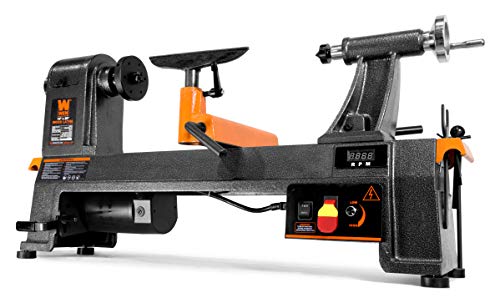
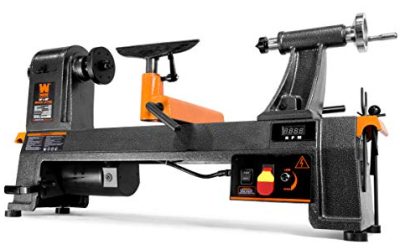
The WEN 34034 is the capacity pick in this guide. As stated on the listing, it has a 14-inch swing over the bed and 20 inches between centers, the largest bowl diameter and nearly the longest spindle capacity here, driven by a 6-amp motor. Turners whose projects lean toward wider bowls and platters will notice the swing figure first: two extra inches over the bed is the difference between a blank fitting the lathe and not fitting it at all.
Speed is variable from 600 to 3,200 RPM, as recorded from the listing copy. That range is aimed at general turning and finishing rather than the very slow truing of rough blanks; there is no low range like the JET and RIKON provide, so large, out-of-balance pieces should be prepared carefully before mounting. The headstock and tailstock tapers are MT2, the common size for centers and chucks in this class, so the lathe fits the standard accessory ecosystem. The base is cast iron, which is the right material under a lathe: mass in the base keeps vibration down when a blank is not yet round.
The reverse function is a forward and reverse switch, and the listing copy ties it to two specific jobs: sanding in alternate directions and cutting inside bowls. That matches how reverse earns its place in practice: alternating the sanding direction gives a more even surface on figured wood, and the inside wall of a bowl can be reached from a stance where the tool is presented correctly once the spindle direction is flipped.
The trade-offs are stated in its own figures. The motor is rated in amps rather than horsepower, the speed range begins at 600 RPM, and the listing does not record a digital readout or indexing positions. In return it gives the biggest working envelope in this guide on a cast iron base, with the reverse switch the keyword requires.
Specs
– Model: 34034
– Motor: 6-amp
– Swing over bed: 14 inches
– Between centers: 20 inches
– Speed: variable speed, 600 to 3,200 RPM, as recorded from the listing copy
– Reverse: forward and reverse switch, as stated on the listing
– Tapers: MT2 headstock and tailstock
– Base: cast iron
Pros
– Largest swing in this guide at 14 inches, with 20 inches between centers
– Forward and reverse switch suited to sanding and cutting inside bowls
– MT2 tapers fit the standard accessory range
– Cast iron base for stability
Cons
– Speed range begins at 600 RPM, with no very low range for rough blanks
– No digital readout or indexing positions recorded on the listing
Delta 46-460 12-1/2 Inch Variable-Speed Midi Lathe
The Delta 46-460 is the established midi name in this guide. As stated in the referencing material for its listing, it runs a 1 HP motor, with a 12-1/2 inch swing over the bed and 16-1/2 inches between centers. That half inch of extra swing over the JET and RIKON is a small but real difference for bowl turners working near the 12-inch mark.
Speed control is electronic variable speed, and the machine carries a forward/reverse function, which is what places it in this guide at all. Reverse on a midi lathe of this size is used the same way as on the larger machines: alternate the direction while sanding, and flip the spindle when a cut inside a bowl is easier from the other side of the bed.
The honest note for this model is that fewer figures were recorded from its listing than for the other three: the available material confirms the motor, swing, bed length, electronic variable speed and the reversing function, but does not record a detailed speed range, readout or indexing specification. A buyer comparing on numbers alone should weigh that against the fuller specification recorded for the JET and RIKON.
Within this guide, the Delta is the pick for a turner who wants the reversing function in a midi format with a touch more swing than the standard 12 inches. It should not be confused with non-reversing midi lathes of similar size, which were left out.
Specs
– Model: 46-460
– Motor: 1 HP
– Swing over bed: 12-1/2 inches
– Between centers: 16-1/2 inches
– Speed: electronic variable speed
– Reverse: forward/reverse (reversing) function, as stated in the referencing material
Pros
– 1 HP motor with electronic variable speed and a reversing function
– 12-1/2 inch swing, slightly wider than the 12-inch models here
– Midi format with 16-1/2 inches between centers
Cons
– Fewer specifications recorded from its listing than the other lathes here
– No speed range figures recorded, so compare carefully on that point
How to Choose
Confirm the reverse function first, and confirm it from the listing rather than from the lathe’s general reputation. Several well-known benchtop lathes in this size class have no reverse at all, and a variable speed dial is not evidence of one. If a listing describes only speed control, assume the spindle runs one way.
Next, match swing and bed length to the work. Swing over the bed sets the largest diameter that can turn: 12 inches on the JET and RIKON, 12-1/2 on the Delta and 14 on the WEN. Distance between centers sets the longest spindle: the JET leads at 21 inches, the WEN follows at 20, and the RIKON and Delta sit at 16-1/2. Bowl turners should weight swing more heavily; spindle turners should weight bed length.
Then look at the bottom of the speed range, not only the top. Truing a rough, unbalanced blank is done slowly, and the JET’s range reaching down to 60 RPM is a genuine advantage there, ahead of the RIKON’s 250 RPM floor and the WEN’s 600 RPM floor. At the other end, the lathes with recorded figures reach at least 3,200 RPM, which covers small spindle work and finishing cuts.
Motor and build come after that. The JET, RIKON and Delta are all listed at 1 HP; the WEN is listed by its 6-amp motor. Weight and base material affect how a lathe behaves with an out-of-round blank: the JET is listed at 121 lb, the RIKON at 95 lb, and the WEN uses a cast iron base. A heavier machine vibrates less, but it also claims its bench space permanently.
Finally, count the working details. A digital readout, as fitted to the JET and RIKON, makes it easier to repeat a speed and hold it across a direction change. Indexing positions, 24 on the JET, support layout tasks. Included centers and a faceplate, as listed for the RIKON, reduce what has to be bought before the first project. Check the tapers too: MT2 fittings, as on the WEN, keep accessory choices standard.
FAQs
Why does reverse rotation matter on a benchtop wood lathe?
Reverse lets the turner work the wood from the other direction without moving to an awkward position. Its most common use is sanding: alternating the spindle direction between passes works the surface both ways, which helps produce an even finish on bowls and hollow forms. It also helps when cutting inside a bowl, where reversing the spindle presents the tool correctly from a comfortable stance.
Can any variable speed lathe be run in reverse?
No. Variable speed and reverse are separate features. A lathe can change speed electronically and still run in one direction only, and several popular benchtop models do exactly that. The four lathes here were selected because their listings state a forward/reverse switch or a reversing function; if a listing does not say so, treat the lathe as forward-only.
Which of these lathes suits the largest work?
By diameter, the WEN 34034, with a 14-inch swing over the bed. By length, the JET JWL-1221VS, with 21 inches between centers, followed by the WEN at 20 inches. A turner making wide bowls should start from the swing figure; a turner making longer spindles should start from the distance between centers.
Conclusion
For most benchtop turners who need reverse rotation, the JET JWL-1221VS is the top pick: 1 HP, 21 inches between centers, a speed range reaching down to 60 RPM, a forward/reverse switch with a smooth transition, indexing and a digital readout. The RIKON 70-150VSR is the runner-up, lighter at 95 lb with a 1 HP DC motor, reverse with a readout in both directions and the centers and faceplate included. The WEN 34034 gives the largest swing at 14 inches on a cast iron base, and the Delta 46-460 pairs a 1 HP motor with a 12-1/2 inch swing in a midi format. Whichever model is chosen, confirm on the live listing that the reverse function is present before ordering, since that single feature separates these four from the many benchtop lathes that run in one direction only.
More from Amazon
Programs that pair well with the guide above. Offers and eligibility are set by Amazon and may change.
Free shipping on eligible items, Prime Video and more. Eligible new members can start with a free trial.
Start a Prime free trialAudiobooks and podcasts to listen to on the go. Eligible new members can start with a free trial.
Try Audible freeAd-free music streaming. Eligible new subscribers can start with a free trial.
Try Music Unlimited freeA free business account with business pricing and bulk-buying tools for work, shop or home office.
Create a business accountAs an Amazon Associate we earn from qualifying purchases.
Write Your Review
No reviews yet. Be the first to share your experience!