
Key takeaways
- Compare the best midi wood lathes with digital speed displays — four benchtop picks with live RPM readouts, wide speed ranges and up to 14-inch swing.
Introduction
A digital speed display changes how a midi lathe feels in daily use. Instead of guessing spindle speed from a dial position or a chart taped to the wall, you see the actual RPM on a readout and can dial in the same setting every time — slow for roughing out an unbalanced bowl blank, faster for sanding and finishing, and back again without counting pulley steps. For turners who move between pens, spindles, and small bowls in a single session, that repeatability is the difference between a lathe that slows you down and one that keeps up.

This guide is for hobbyist and intermediate turners who want benchtop capacity without giving up a full-size lathe’s floor space. The four lathes below were chosen from their Amazon listings based on the specs that matter for this category: swing and distance between centers, motor output, the low and high ends of the speed range, and a genuine digital RPM readout. Every model here is a midi-format benchtop lathe with electronic variable speed, so the real differences are in capacity, low-speed control, and how the display and controls are laid out.
Quick Picks
Our Short List of 3
- Best for: Turners who want the most capacity a benchtop midi lathe can provide, especially larger bowls and longer spindles.
- Brand: WEN
- Model Number: 34035
- Motor: 6-amp
- Swing over bed: 14 inches
- Best for: Bowl turners who value low-speed torque, reverse sanding, and flexible control placement.
- Brand: RIKON
- Model Number: 70-150VSR
- Motor: 1 HP DC, 6 amps, 120V
- Swing over bed: 12 inches

- Best for: Pen turners and small-project makers who spend most of their time at higher speeds on a standard 12 x 18 footprint.
- Brand: CXRCY
- Model Number: MC1218
- Motor: 3/4 HP
- Swing over bed: 12 inches
All 4 Picks at a Glance
| Product | Specs | Action |
|---|---|---|
| WEN 34035 6-Amp 14″ x 20″ Variable Speed Benchtop Wood Lathe |
| Check price on Amazon |
| RIKON 70-150VSR VSR Midi Lathe |
| Check price on Amazon |
| CXRCY 12″ x 18″ Wood Lathe with Digital Display (MC1218) |
| Check price on Amazon |
 MECHINHUB 12″ x 18″ Digital Display Wood Lathe (MGCC) |
| Check price on Amazon |
How to Choose
Swing and distance between centers
Swing is the largest diameter blank the lathe can spin over the bed, and distance between centers is the longest spindle it can hold. A 12-inch swing covers most bowls and platters a hobbyist will attempt, while a 14-inch swing like the WEN’s opens up larger salad bowls and wider faceplate work. Length matters less for bowl turners but is decisive for anyone turning table legs, tool handles, or baseball-bat-style spindles: 16-1/2 inches handles short spindles, 18 inches covers most furniture parts, and 20 inches gives comfortable headroom. Match the capacity to the work you actually plan, because extra cast iron you never use is just extra weight on the bench.
Speed range and belt ranges
All four lathes here use electronic variable speed across three belt ranges, so the headline range is really three overlapping bands. What matters is both ends of it. The low end decides how safely you can start a large, out-of-round blank: 250 RPM is far more forgiving than 650 RPM when a bowl blank is still unbalanced. The high end matters for small work — pens, finials, and bottle stoppers turn and finish best at higher speeds. Note that changing ranges still means moving a belt on pulleys; the electronics fine-tune speed within the range you select, and the digital display confirms where you actually are.
Motor type and power
Motor output determines how aggressively you can cut before the lathe bogs down. The two 3/4 HP machines here are well matched to their 12-inch capacity, while the RIKON’s 1 HP DC motor delivers stronger low-speed torque, which is exactly where heavy roughing cuts happen. The WEN takes a different route with a 6-amp motor driving the largest capacity in this group. DC motors in particular tend to hold speed under load at the bottom of the range, so if you plan to core bowls or turn dense, wet blanks, prioritize torque over a high top speed you may rarely use.
Display and control layout
The display itself is the point of this category, but placement and extras differ. A front-panel readout like the WEN’s LCD is easy to glance at mid-cut. The RIKON adds a magnetic control box you can position where it suits your stance, and its readout works for both forward and reverse turning — reverse is genuinely useful for sanding, since it lets you work the piece from the comfortable side. When comparing listings, confirm the display shows actual spindle RPM rather than a motor setting, and check whether controls stay reachable when a large blank is mounted.
The 4 Best Options
WEN 34035 6-Amp 14″ x 20″ Variable Speed Benchtop Wood Lathe
- Best for: Turners who want the most capacity a benchtop midi lathe can provide, especially larger bowls and longer spindles.
- Brand: WEN
- Model Number: 34035
- Motor: 6-amp
- Swing over bed: 14 inches
Turners who want the most capacity a benchtop midi lathe can provide, especially larger bowls and longer spindles.
The bigger bed needs a sturdy, spacious bench, and the 3550 RPM ceiling is a touch lower than the 3800 RPM models if you turn very small pieces at maximum speed.
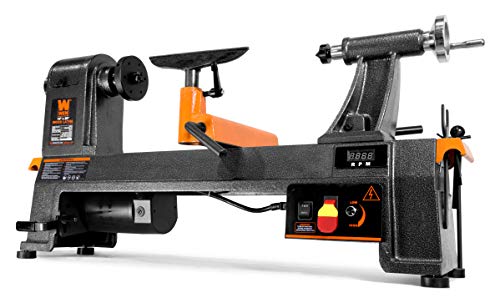
The WEN 34035 is the capacity pick of this group. Its 14-inch swing and 20 inches between centers are the largest figures here, which makes it the natural choice for turners whose projects keep outgrowing a 12-inch lathe — wider bowls, longer spindles, and furniture parts that would not fit the other three machines. The 6-amp motor drives a three-range variable-speed system that starts at a genuinely low 250 RPM, so big blanks can be trued up gently before you bring the speed up.
The digital/LCD RPM readout sits on the front control panel, right where your hand falls when adjusting speed, and both the headstock and tailstock use MT2 tapers, so the chucks, centers, and mandrels from a typical midi setup carry over. The trade-off for the extra capacity is footprint and weight on the bench, and its top speed of 3550 RPM is slightly lower than the two 3800 RPM machines — irrelevant for bowls, worth noting for tiny spindle work.
Watch out for: The bigger bed needs a sturdy, spacious bench, and the 3550 RPM ceiling is a touch lower than the 3800 RPM models if you turn very small pieces at maximum speed.
RIKON 70-150VSR VSR Midi Lathe
- Best for: Bowl turners who value low-speed torque, reverse sanding, and flexible control placement.
- Brand: RIKON
- Model Number: 70-150VSR
- Motor: 1 HP DC, 6 amps, 120V
- Swing over bed: 12 inches
Bowl turners who value low-speed torque, reverse sanding, and flexible control placement.
The 16-1/2 inches between centers is the least here, so it is not the pick for long spindle work, and the 3200 RPM top speed is the lowest of the four.
The RIKON 70-150VSR is built around control at the slow end. Its 1 HP DC motor is the strongest in this group, and the electronic variable speed runs from 250 to 3200 RPM across three ranges, with the bottom range starting at 250 RPM for careful roughing. The digital readout reports speed for both forward and reverse turning, which sets it apart: reverse rotation is a real advantage when sanding bowls, because it lets you keep the work on the side of the lathe where you have the best light and stance.
RIKON also thought about the physical setup. The control box is magnetic, so you can mount it on the headstock, the bed, or wherever your hand naturally rests, and the package includes a spur center, a live center, a 3-inch faceplate, and a 6-inch tool rest, so the lathe is ready for both spindle and faceplate work out of the box. Capacity is the compromise: at 12 inches of swing and 16-1/2 inches between centers, it is the shortest lathe here, so long spindles will push its limits.
Watch out for: The 16-1/2 inches between centers is the least here, so it is not the pick for long spindle work, and the 3200 RPM top speed is the lowest of the four.
CXRCY 12″ x 18″ Wood Lathe with Digital Display (MC1218)
- Best for: Pen turners and small-project makers who spend most of their time at higher speeds on a standard 12 x 18 footprint.
- Brand: CXRCY
- Model Number: MC1218
- Motor: 3/4 HP
- Swing over bed: 12 inches
Pen turners and small-project makers who spend most of their time at higher speeds on a standard 12 x 18 footprint.
The 650 RPM minimum speed is the highest floor in this group, so it is the least forgiving choice for large, out-of-round bowl blanks.
The CXRCY MC1218 is a straightforward 12 x 18 midi lathe aimed at turners whose work leans small and fast. Its 3/4 HP motor drives an infinitely variable speed system topping out at 3800 RPM — the joint-highest here — which suits pens, stoppers, finials, and other small-diameter pieces that finish best at high spindle speeds. The high-definition digital display shows spindle RPM clearly, so repeating a favorite sanding or finishing speed takes seconds.
Capacity is the standard midi footprint: 12 inches of swing and 18 inches between centers covers bowls up to roughly platter size and most furniture spindles. The honest limitation is the bottom of the speed range. The lowest range starts at 650 RPM, which is brisk for a large, unbalanced bowl blank; turners who rough out big green-wood bowls will feel that floor, while anyone working with smaller, balanced stock will not notice it at all.
Watch out for: The 650 RPM minimum speed is the highest floor in this group, so it is the least forgiving choice for large, out-of-round bowl blanks.
MECHINHUB 12″ x 18″ Digital Display Wood Lathe (MGCC)
- Best for: Hobbyists who want a standard 12 x 18 midi lathe with a high top speed for mixed small-to-medium projects.
- Brand: MECHINHUB
- Model Number: MGCC
- Motor: 3/4 HP 110V pure-copper motor
- Capacity: 12-inch diameter x 18-inch length
Hobbyists who want a standard 12 x 18 midi lathe with a high top speed for mixed small-to-medium projects.
The 650 RPM starting speed limits how gently you can rough out large unbalanced blanks, and the mid-range figures differ only slightly from the CXRCY, so there is no capacity advantage either way.
The MECHINHUB MGCC covers the same 12 x 18 ground as the CXRCY with a spec sheet built around its motor: a 3/4 HP, 110V pure-copper motor, a construction the listing highlights for steady output. Speed is infinitely variable from 650 to 3800 RPM across low, mid, and high ranges, and the HD digital display reports spindle RPM so you can return to a known setting for each stage of a project.
In practice this is a general-purpose midi lathe for the classic mix of hobby work — small bowls, spindles, handles, and turned boxes — on a benchtop footprint. Like the CXRCY, its range starts at 650 RPM rather than 250, so it is better matched to balanced blanks and smaller work than to roughing out large, irregular bowl stock. Between the two 12 x 18 machines, the choice comes down to motor construction and which listing’s control layout you prefer, since capacity and speed figures are nearly identical.
Watch out for: The 650 RPM starting speed limits how gently you can rough out large unbalanced blanks, and the mid-range figures differ only slightly from the CXRCY, so there is no capacity advantage either way.
Which One Fits Your Situation
You turn bowls more than anything else
Choose between the WEN 34035 and the RIKON 70-150VSR. Both start at 250 RPM, which lets you true up an unbalanced blank safely. The WEN wins on size, with 14 inches of swing for wider bowls; the RIKON wins on torque and reverse sanding, with its 1 HP DC motor and readout that works in both directions.
You mostly turn pens and small spindle work
The CXRCY MC1218 and MECHINHUB MGCC are your machines. Their 3800 RPM top speeds suit small-diameter work, and you will never miss the low-speed floor you are giving up. Pick the MECHINHUB if its pure-copper motor appeals, or the CXRCY if you prefer its control setup — capacity is the same.
Your projects keep getting longer
The WEN 34035, with 20 inches between centers, is the only one of the four that comfortably handles longer spindles and furniture parts without an extension. The two 18-inch machines manage most parts; the RIKON’s 16-1/2 inches will feel tight.
You are upgrading from a fixed-speed mini lathe
Any of the four is a step up in capacity, but the RIKON’s magnetic control box and included centers and faceplate make the transition easiest, since the starter accessories are already in the box and the controls can sit exactly where your old lathe’s switch used to be.
Common Mistakes
- Ignoring the low end of the speed range. A lathe that starts at 650 RPM is fine for pens but unforgiving on a large, unbalanced bowl blank. Match the minimum speed to your biggest work, not your average work.
- Assuming the display removes belt changes. These lathes still use three belt ranges. The electronics adjust speed within a range; you still move the belt to switch ranges, and the readout simply confirms the result.
- Buying swing and forgetting length. A 14-inch swing does not help if your spindle is longer than the distance between centers. Check both numbers against your project list.
- Overlooking taper compatibility. The WEN uses MT2 headstock and tailstock tapers. Confirm your existing chucks, mandrels, and centers match a lathe’s tapers before assuming your accessories carry over.
- Running small work too slowly. Pens and finials cut and sand cleanly at high RPM. A display makes it easy to set the right speed — use it instead of leaving the lathe wherever it was last set.
Frequently Asked Questions
What does the digital display on a midi lathe actually show?
It shows the spindle’s rotational speed in RPM, read from the lathe’s sensor as it runs. That means the number reflects the real speed under load, not just the dial position, so you can return to an exact setting for repeat operations like sanding a set of matching spindles.
Do I still need to move a belt on a variable-speed lathe with a display?
Yes, on all four lathes here. Each uses three belt ranges, and the electronic control varies speed within the selected range. Moving the belt takes a moment, and the display confirms the new speed as soon as you restart the lathe.
How slow does a lathe need to go for bowl turning?
For roughing out an unbalanced bowl blank, a starting speed around 250 RPM is far more forgiving than 650 RPM, because the blank’s wobble forces grow quickly with speed. Once the blank is round and balanced, you can raise the speed for shaping and finishing regardless of which lathe you own.
What is the difference between a mini and a midi lathe?
Midi lathes are the middle benchtop class: typically 12 to 14 inches of swing and 16 to 20 inches between centers, with stronger motors than mini lathes. They handle bowls and furniture parts that strain a mini, while still sitting on a workbench instead of needing a dedicated stand and floor space.
Related Guides
- Best benchtop wood lathes for small workshops
- Best wood lathe chucks for bowl turning
- Best lathe tool sets for beginners
- Best dust collection for a home turning shop
As an Amazon Associate, we earn from qualifying purchases.
More from Amazon
Programs that pair well with the guide above. Offers and eligibility are set by Amazon and may change.
Free shipping on eligible items, Prime Video and more. Eligible new members can start with a free trial.
Start a Prime free trialAudiobooks and podcasts to listen to on the go. Eligible new members can start with a free trial.
Try Audible freeAd-free music streaming. Eligible new subscribers can start with a free trial.
Try Music Unlimited freeA free business account with business pricing and bulk-buying tools for work, shop or home office.
Create a business accountAs an Amazon Associate we earn from qualifying purchases.

Write Your Review
No reviews yet. Be the first to share your experience!