

Key takeaways
- Compare four pulse TIG welders with foot pedals for aluminum, stainless and thin steel. Learn how pulse, AC/DC output and pedal control shape the right pick.
A pulse TIG welder with a foot pedal changes how much heat you can put into a joint while the arc is still running. Instead of stopping to turn a knob, you press the pedal to raise the current for penetration, ease off as thin metal heats up, and taper down at the end of a bead so the crater does not crack. Pulse adds a second layer of control by switching between a high peak current and a lower background current, which narrows the heat-affected zone on sheet metal, stainless tubing and aluminum.

This guide suits home-shop fabricators, hobby welders moving from stick or MIG to TIG, and small-shop owners who weld aluminum as well as steel. The four machines below were chosen from their Amazon listing names and specifications: every one lists pulse TIG and foot-pedal control, every one lists AC/DC TIG for aluminum and steel, and each one covers a different combination of output, input voltage and included accessories.
Quick Picks
As an Amazon Associate we earn from qualifying purchases
| Product | Best for | Key spec from title |
|---|---|---|
| YESWELDER TIG-250P 250 Amp AC/DC Aluminum Tig Welder with Pulse | High-output aluminum and stainless work on a 220V circuit | 250 Amp AC/DC Aluminum Tig Welder with Pulse |
| Weldpro 200A AC/DC TIG Welder with Pulse | A complete dual-voltage kit for aluminum and thin steel | 200A AC/DC TIG Welder with Pulse, 110V/220V Dual Voltage |
| YESWELDER TIG-200P ACDC 200A AC/DC Aluminum Tig Welder | Dual-voltage shop work with a large display and several TIG modes | 200A AC/DC Aluminum Tig Welder, TIG-200P ACDC |
| AHP AlphaTIG 203Xi Amp IGBT AC DC Tig/Stick Welder with Pulse | Detailed AC control with a long-cord pedal and torch in the box | 200 Amp IGBT AC DC Tig/Stick Welder with Pulse, 110/220V |
How to Choose
AC or DC Output Decides Which Metals You Can Weld
Aluminum needs AC TIG, because the alternating current breaks up the oxide layer on the surface while the arc is running. Steel, stainless steel, copper and titanium run on DC TIG. A machine that lists only DC TIG will leave aluminum work unfinished, no matter how high its amperage goes. All four welders in this guide list AC/DC TIG, so the difference lies in how much AC adjustment each one gives you. Look for AC balance and AC frequency controls when aluminum is a regular job, and check whether the listing states a square-wave mode, since that shape of AC output is the one most often paired with aluminum fabrication.
Pulse Settings Control Heat on Thin Material
Pulse frequency, peak amperage and pulse width decide how much heat the arc puts into the workpiece between pulses. A low pulse frequency gives a visible ripple in the bead and a slower, more deliberate pace, which helps on thin sheet and open-root joints. A higher frequency concentrates the arc and keeps distortion down on stainless tubing and thin aluminum. The Weldpro lists a pulse frequency range of 0.5 to 200 Hz, while the YESWELDER TIG-250P lists AC square-wave adjustment from 20 to 250 Hz. Compare those ranges against the thickness you weld most, and favour a machine that lets you change peak current and upslope and downslope rather than one that offers a single fixed pulse setting.
Foot Pedal Design Matters More Than It Looks
A foot pedal is not just an on-off switch. A rocker-style pedal lets you feather the current through a long seam, while a stiff or short-travel pedal makes fine control harder at low amperage. The Weldpro listing names a heavy-duty rocker foot pedal, the YESWELDER TIG-250P listing names a 5-pin metal foot pedal, and the AHP listing names a Nova foot pedal with a 25 ft cord. Cord length matters when the machine sits on a cart and you weld at a bench, and the plug type matters when a pedal ever needs replacing. Before ordering, confirm that the exact listing variant includes the pedal, because some welders in this class support a pedal that is sold separately.
Input Voltage and Duty Cycle Set Where the Machine Can Work
A dual-voltage welder that accepts 110V and 220V can run from a household outlet for light work and from a 220V circuit for full output, while a 220V-only machine needs that circuit before it will weld at all. The YESWELDER TIG-250P runs on 220V only, so it suits a shop that already has that supply. Duty cycle states how long the machine can weld at a given current in a ten-minute period, and it falls as current rises. The TIG-250P lists 60 percent duty cycle at 250A and 100 percent at 183A for TIG, and the Weldpro lists 40 percent at its full 200A output. Match those figures to your longest beads rather than to headline amperage alone.
The 4 Best Options
YESWELDER TIG-250P 250 Amp AC/DC Aluminum Tig Welder with Pulse
This is the pick for a fabricator who already has a 220V supply and wants the highest output in this group for aluminum, stainless and carbon steel. Its 5-amp low end suits thin sheet, its 250-amp top end covers thicker plate, and the spot-weld timer and 2T/4T trigger options help with repeated panel work and long seams. A buyer who welds auto body panels, aluminum fabrication and stainless projects in the same shop will get the most from the wide current range and the AC square-wave adjustment.
Specs
- 250 Amp AC/DC aluminum TIG welder with pulse, digital inverter TIG/Stick, 220V
- TIG output 5 to 250 amps; Stick output 10 to 200 amps
- AC/DC TIG, AC/DC pulse TIG, Stick, and argon arc spot welding
- AC square wave adjustable between 20 and 250 Hz
- 60 percent duty cycle at 250A and 100 percent duty cycle at 183A for TIG
- WP-26 TIG torch, 13 ft, with a 5-pin metal foot pedal
- Spot-weld timer and 2T/4T trigger lock
- 23.24 lb; 17.32 x 7.68 x 13.58 inches
Best for: High-output aluminum and stainless fabrication on a dedicated 220V circuit.
Watch out for: Confirm the 220V-only input against your workshop supply before ordering, because this machine does not list dual-voltage operation, and check that a gas regulator is in the box for the exact variant you choose.
ASIN: B08CBD1L69
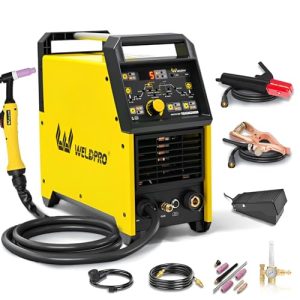
Weldpro 200A AC/DC TIG Welder with Pulse
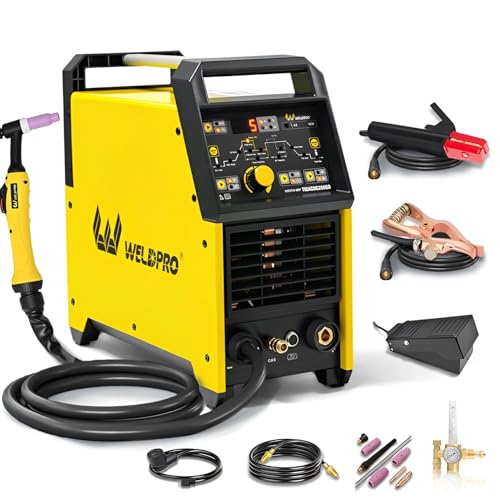
A home-shop welder who needs aluminum capability, dual-voltage flexibility and a full accessory kit in one box will find this Weldpro the most complete package here. Its five listed modes cover high-frequency AC TIG, DC TIG, AC pulse TIG, DC pulse TIG and Stick, so one machine handles thin aluminum, stainless and mild steel without changing processes. The rocker foot pedal, flow meter, ground clamp and torch arrive with the machine, which shortens the list of extras a first-time TIG buyer has to source separately.
Specs
- 200A AC/DC TIG welder with pulse, 110V/220V dual voltage, 5-in-1 multiprocess machine
- High-frequency AC TIG, DC TIG, AC pulse TIG, DC pulse TIG, and Stick MMA
- Automatic dual-voltage detection and switching between 110V and 220V
- Pulse frequency 0.5 to 200 Hz, with adjustable peak amperage, upslope and downslope
- 2T/4T trigger modes and a large HD LED display
- 40 percent duty cycle at full 200A output
- IGBT inverter technology with overheat, over-current, over-voltage and under-voltage protection
- Included components: flow meter, foot pedal, gas hose, ground clamp and torch
- Item model number TIG200-KT26 Torch; 61.8 lb; 17.6 x 7.9 x 16.2 inches
Best for: A dual-voltage home shop that wants aluminum, pulse and stick work from one ready-to-assemble kit.
Watch out for: Check the exact listing variant and its included torch before ordering, because this model family has also appeared under a separate older listing, and confirm the argon cylinder and filler metal are arranged separately.
ASIN: B0FQX7TJNX
YESWELDER TIG-200P ACDC 200A AC/DC Aluminum Tig Welder

This YESWELDER suits a buyer who wants 200 amps and dual-voltage input with a large, readable display and several TIG modes to learn on. Its listing describes seven welding modes including AC/DC TIG and pulse options, plus high-frequency non-touch arc starting, which helps a newer TIG welder strike an arc without touching the tungsten to the workpiece. The dual-voltage input means the same machine can move between a household outlet for practice and a 220V outlet for heavier jobs, provided the output limits on each input are understood.
Specs
- 200A AC/DC aluminum TIG welder, model TIG-200P ACDC
- AC/DC TIG and Stick welding, with pulse control
- Dual-voltage input
- High-frequency non-touch arc start
- Large LED display
- 7-in-1 welding modes including AC/DC TIG and pulse options
- Foot pedal named in the listing
Best for: Dual-voltage learning and general shop work where a clear display and several TIG modes matter.
Watch out for: Confirm on the exact listing whether the foot pedal is included in the box or described only as a supported interface, because descriptions for this model vary on that point, and check the output available on 110V before planning thicker work.
ASIN: B0C8J6Z4BF
AHP AlphaTIG 203Xi Amp IGBT AC DC Tig/Stick Welder with Pulse
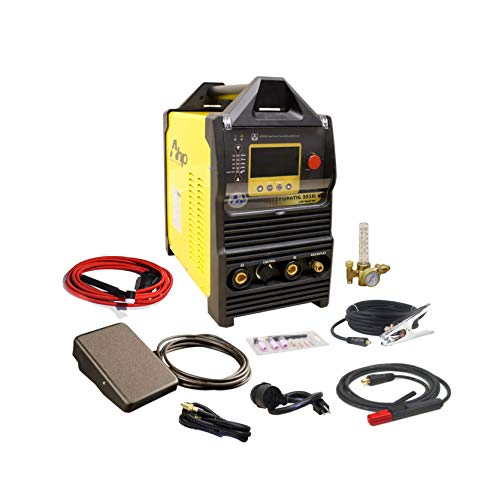
A buyer who values a long pedal cord, a named torch and regulator in the box, and adjustable AC controls will get the most from this AHP. The listing names a Nova foot pedal with a 25 ft cord, a Nova Rotaflex 9/17 TIG torch and a floating-ball billet brass argon regulator, which together cover the reach and gas control that cheaper kits often leave out. Its IGBT inverter design, LCD screen and pulse settings suit detailed aluminum and stainless work where the operator wants to shape the arc rather than accept a fixed setup.
Specs
- 200 Amp IGBT AC DC Tig/Stick welder with pulse, 110/220V
- AC/DC TIG and Stick welding with pulse technology and high-frequency start
- LCD screen
- Nova foot pedal with 25 ft cord included
- Nova Rotaflex 9/17 TIG torch, 12.5 ft, with 35-70 DINSE connection
- Floating-ball billet brass argon regulator
- 250A stick electrode holder, 9 ft, and work clamp, 6 ft
- 240V to 120V plug adapter included
- Basic consumable kit included; tungsten not included in that kit
Best for: Detailed AC/DC TIG work where a long pedal cord and a complete torch and regulator package matter.
Watch out for: Check the model year and pedal type on the exact listing before ordering, because this welder is also sold in a separate wireless-pedal bundle under a different ASIN, and confirm tungsten and filler rod are on hand before the first weld.
ASIN: B076BSD6PG
Which One Fits Your Situation
You Weld Aluminum Often and Have a 220V Circuit
Choose the YESWELDER TIG-250P. Its 250-amp top end, AC square-wave adjustment and 60 percent duty cycle at 250A give it the widest headroom for aluminum plate and stainless fabrication, and its 5-amp low end still handles thin sheet. The 220V-only input is no drawback when that circuit is already in place, and the spot-weld timer helps with repeated panel joints.
You Want One Kit That Works in a Garage and a Shop
Choose the Weldpro 200A. Automatic dual-voltage switching, five listed TIG and stick modes, a rocker foot pedal and a full accessory kit including a flow meter and ground clamp mean fewer separate purchases for a first TIG setup. Its 40 percent duty cycle at 200A is the figure to plan longer beads around, and the LED display keeps parameter changes visible in a busy garage.
You Are Learning TIG and Need a Clear Display
Choose the YESWELDER TIG-200P ACDC. Its large LED display, high-frequency non-touch start and seven listed welding modes give a newer welder room to practise AC and DC TIG, pulse and stick work without changing machines. Dual-voltage input adds flexibility, as long as the pedal contents and the 110V output limits are confirmed on the exact listing first.
You Want Reach and AC Control for Detailed Work
Choose the AHP AlphaTIG 203Xi. The 25 ft pedal cord and 12.5 ft torch give more freedom around a bench or a larger workpiece, and the included argon regulator and plug adapter cover two items that are easy to overlook. Its pulse settings and LCD screen suit careful aluminum and stainless jobs where small changes to the arc make a visible difference to the bead.
Welding Safety Before You Strike an Arc
TIG welding uses mains electricity, intense ultraviolet light and hot metal, so set up the work area before switching the machine on. Wear an auto-darkening welding helmet, flame-resistant clothing and welding gloves, and keep bystanders and flammable material away from the arc. Weld in a ventilated area, keep the argon cylinder upright and secured, and check that the torch, ground clamp, pedal cable and power lead are undamaged before each session. The Weldpro listing names overheat, over-current, over-voltage and under-voltage protection, but those built-in protections do not replace a dry floor, a sound earth connection and a machine that is switched off and unplugged before the torch or cables are changed. Read the manual supplied with the exact machine you buy, and do not weld on a closed container or a workpiece that may hold fuel, gas or pressure.
Common Mistakes
- Buying a DC-only TIG welder and then discovering it cannot weld aluminum, which needs AC TIG.
- Choosing a 220V-only machine for a workshop that has no 220V circuit wired and ready to use.
- Assuming a foot pedal is in the box when the listing only says pedal control is supported, and then paying extra for the pedal and its plug type.
- Ignoring duty cycle and planning long, high-current beads on a machine rated for short runs at full output.
- Starting a first TIG project without argon, tungsten, filler rod and a regulator, which are not all included with every kit.
Frequently Asked Questions
Do I need AC TIG to weld aluminum with a pulse TIG welder?
Yes, aluminum needs AC TIG, because the alternating current cleans the oxide layer from the surface as the arc runs. DC TIG suits steel, stainless steel and copper, but it does not give the same cleaning action on aluminum. All four welders in this guide list AC/DC TIG, so check the AC balance and frequency controls on the exact listing when aluminum is a regular part of your work.
What does pulse actually do on thin metal?
Pulse switches the arc between a high peak current and a lower background current, which lowers the average heat going into the joint. That helps prevent burn-through on thin sheet and reduces distortion on stainless tubing, while the peak current still gives enough penetration to form a sound bead. Adjusting pulse frequency and peak current lets you change the bead ripple and the heat input for each thickness.
Is a foot pedal better than a torch trigger for TIG welding?
A foot pedal gives amperage control during a weld, so you can start hot, ease off as the metal warms and taper down at the end. A torch trigger gives on-off control or a fixed 2T/4T sequence, which suits long straight seams but gives less fine control on corners and thin sections. Many welders use the pedal at the bench and the trigger when a pedal is awkward to reach.
Can I run a pulse TIG welder from a standard household outlet?
Some dual-voltage models list 110V operation, including the Weldpro 200A, the YESWELDER TIG-200P ACDC and the AHP AlphaTIG 203Xi, but output is lower on 110V than on 220V. The YESWELDER TIG-250P lists 220V only, so it needs that circuit. Check the listing for the output on each voltage, confirm the circuit and breaker suit the machine, and do not assume a household outlet will deliver full rated amperage.
More from Amazon
Programs that pair well with the guide above. Offers and eligibility are set by Amazon and may change.
Free shipping on eligible items, Prime Video and more. Eligible new members can start with a free trial.
Start a Prime free trialAudiobooks and podcasts to listen to on the go. Eligible new members can start with a free trial.
Try Audible freeAd-free music streaming. Eligible new subscribers can start with a free trial.
Try Music Unlimited freeA free business account with business pricing and bulk-buying tools for work, shop or home office.
Create a business accountAs an Amazon Associate we earn from qualifying purchases.
Write Your Review
No reviews yet. Be the first to share your experience!