

Key takeaways
- Four linear bench power supplies verified for quality control benches, compared on published ripple, regulation, channels and programming features.
Quality control work puts a bench supply in an unusual position: it is both a tool and part of the measurement. If the supply adds its own switching noise to a board under inspection, ripple that belongs to the supply can be mistaken for a defect, and a marginal unit can pass or fail for the wrong reason. Linear designs avoid that high-frequency noise floor, which is why QC benches still specify them even though they are heavier and less efficient than switching models.
This guide is for incoming-inspection technicians, test engineers running multi-rail products, and bench leads who need repeatable setpoints across shifts. Every pick below is a linear model whose topology is stated in its Amazon listing title or in the maker’s own published data for that exact model, and every figure quoted comes from those listing pages and maker specification sheets.
Quick Picks
As an Amazon Associate we earn from qualifying purchases
| Product | Best for | Key spec from title |
|---|---|---|
| Siglent SPD3303X-E | Multi-rail QC benches needing documented low ripple | 2 x 32 V / 3.2 A channels plus 2.5-5 V channel |
| Rigol DP832 | Split-rail products needing isolated channels | 2 isolated 30 V / 3 A channels plus 5 V / 3 A |
| Korad KA3005P | Scripted single-rail test stations | Programmable 30 V / 5 A with USB and RS232 |
| Tekpower TP3005T | Manual pass/fail checks and rework benches | 0-30 V / 0-5 A linear supply with test leads |
How to Choose
Ripple and noise, in the maker’s own numbers
Ripple is the figure that decides whether a linear supply belongs on a QC bench at all. Makers publish it in millivolts rms, but the bandwidth behind the number changes its meaning: Siglent quotes its figure across 5 Hz to 1 MHz, while Korad quotes across a 20 Hz to 20 MHz band. A supply stating 1 mVrms over a narrow band is not automatically quieter than one stating 2 mVrms over a wide band. Compare the published bandwidths first, then the numbers, and match the result against the noise limits in your own product test specification.
Regulation and readback resolution
Line and load regulation describe how far the output drifts when the mains move or the load changes mid-test. For QC work, look for published constant-voltage regulation around 0.01 percent plus a few millivolts, which all four supplies here state in their data. Readback resolution matters just as much: a display that resolves 10 mV and 1 mA lets an operator log the actual applied voltage against a tight tolerance, while a coarser 0.1 V display forces rounding that can swallow the margin on a borderline unit.
Channel count, isolation and combined modes
Single-rail products need one clean channel and a dependable current limit. Split-rail and mixed-signal products need two or three channels, and isolation decides whether those channels can be wired as independent rails, stacked in series for a higher voltage, or paralleled for more current. The Siglent and Rigol below publish series and parallel behaviour or isolated channel layouts in their specifications. Before standardising on a model, map your product family’s rail list against the channel layout, including any fixed logic rail, so the supply covers the worst-case board rather than the typical one.
Programming, presets and repeatability
QC results only compare across shifts and sites when the setpoints do. Memory presets let an operator recall a stored voltage and current instead of dialling by eye, and a panel lock stops a stored setup being nudged between runs. USB, RS232 or LAN control goes further, letting a test script set the output, log readbacks and stamp results without transcription errors. Decide how your station records evidence: if results are typed into a log by hand, presets and a lock may be enough; if they feed a database, a programmable interface is the safer specification.
The 4 Best Options
Siglent SPD3303X-E
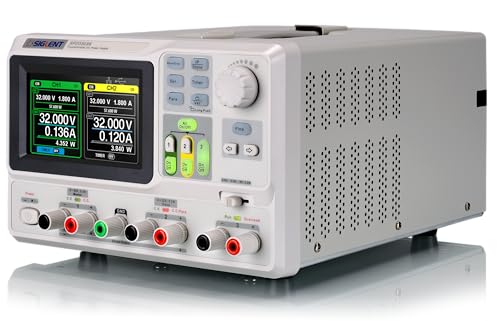
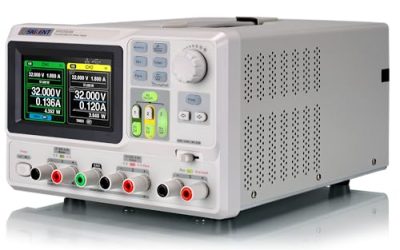
For a QC bench that powers mixed analog and digital products all day, the SPD3303X-E is the most completely documented linear supply in this group. Siglent’s own series data describes the design as linear regulation with ripple and noise at or below 1 mVrms, and the third channel covers the 2.5, 3.3 or 5 V logic rails that inspection fixtures constantly need. USB and LAN control with stored presets suits stations that log results automatically, and the colour display shows both main channels at once, which helps an operator confirm a split-rail setup at a glance before a run starts.
Specs
- 3 channels: CH1 and CH2 adjustable 0-32 V / 0-3.2 A; CH3 selectable 2.5 / 3.3 / 5 V at 3.2 A
- Total output power: 220 W
- Linear regulation; ripple and noise ≤1 mVrms (5 Hz-1 MHz) in constant voltage mode
- Line and load regulation (CV): ≤0.01 percent + 3 mV
- Setting resolution: 10 mV / 10 mA
- 4.3-inch TFT-LCD display; 5 memory presets
- USB and LAN interfaces; series and parallel channel modes
Best for: Multi-rail inspection benches that need published low-ripple figures and logged, repeatable setpoints.
Watch out for: Confirm the X-E’s 10 mV / 10 mA resolution meets your tolerance; the SPD3303X sibling resolves finer, and CH3 carries a ±8 percent output tolerance.
ASIN: B01410O424
Rigol DP832

The DP832 suits QC stations built around split-rail products, where two isolated 30 V channels can feed positive and negative rails while the third channel handles a 5 V logic line. Rigol and its distributors describe the DP800 series model as a programmable linear design, and the channel layout is the point here: isolation lets the same unit serve dual-rail amplifiers, bipolar sensor boards and paired-rail assemblies without a second supply on the bench. A keypad-and-encoder front panel with a colour screen makes stored setups quick to recall during changeovers between product variants.
Specs
- 3 channels: two isolated 0-30 V / 3 A channels plus one 5 V / 3 A channel
- Total output power: 195 W
- Programmable linear DC power supply, DP800 series
- 3.5-inch TFT screen
- Channel isolation supports independent, split-rail wiring
Best for: Test stations checking split-rail or dual-supply products that need genuinely isolated channels.
Watch out for: This model circulates under more than one listing code, so confirm the listing title names the DP832 with the 30 V / 3 A plus 5 V channel layout before ordering.
ASIN: B09S3GQ24H
Korad KA3005P

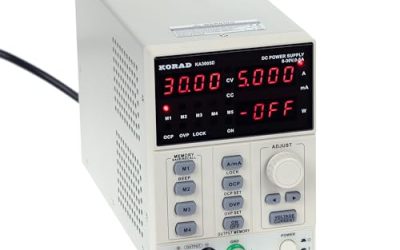
The KA3005P is the single-channel option for QC stations that script their tests. Its Amazon listing title states the linear design outright, and the maker’s manual for the model publishes ripple at or below 2 mVrms with load regulation of 0.01 percent plus 2 mV on voltage. Four front-panel memory locations cover the handful of setpoints a single product family usually needs, and USB plus RS232 control lets a simple script drive the output and record readbacks. A temperature-controlled fan keeps the unit quiet at light loads, and the input voltage selector covers benches in different regions.
Specs
- Single channel, 0-30 V / 0-5 A
- Linear design, stated in the listing title
- Ripple (20 Hz-20 MHz): ≤2 mVrms on voltage
- Load regulation: voltage ≤0.01 percent + 2 mV; current ≤0.1 percent + 10 mA
- Setup resolution: 10 mV / 1 mA; 4-digit LED display
- Four memory locations (M1-M4); panel lock
- USB and RS232 programmable interfaces; switchable 110 V / 220 V input
Best for: Single-rail QC stations that want scripted control and stored setpoints on a compact bench footprint.
Watch out for: Check the rear-panel voltage selector matches your local mains before first power-up, and expect the cooling fan to become audible under sustained heavy load.
ASIN: B0085QLNFM
Tekpower TP3005T

The TP3005T covers the manual end of QC work: first-article checks, rework verification and pass/fail benches where an operator sets voltage and current by knob and watches two back-lit displays. Its listing describes a transformer-based linear design, and the published figures are respectable for manual bench work, with constant-voltage ripple at or below 1 mV rms in the maker’s specification list. Coarse and fine adjustment knobs make it easy to land on an exact setpoint, a button lock guards the setting during a run, and the included alligator test leads suit quick connections to boards and harnesses.
Specs
- Single channel, 0-30 V / 0-5 A
- Transformer-based linear design
- Ripple and noise: CV ≤1 mV rms; CC ≤3 mA rms
- Line regulation: CV <0.01 percent + 3 mV; load regulation: CV <0.01 percent + 3 mV
- Back-lit displays with 0.1 V / 0.01 A resolution
- Coarse and fine adjustment; constant voltage and constant current modes
- Input: 110 V AC, 60 Hz; alligator test leads included
Best for: Manual inspection and rework benches that need a quiet linear output without programming features.
Watch out for: There are no memory presets or a PC interface, so setpoints are dialled and logged by hand each run, and the input is 110 V only.
ASIN: B00ZBCLJSY
Which One Fits Your Situation
Incoming inspection of mixed analog and digital boards
Choose the Siglent SPD3303X-E. One unit powers the main rails and the logic rail together, its published ripple figure is the joint-lowest here, and LAN or USB logging means inspection results land in your records without handwritten setpoints. The five presets cover a small family of related boards without reconfiguring the bench between lots.
Split-rail product testing
Choose the Rigol DP832. Its two isolated 30 V channels map directly onto positive and negative rails, and the separate 5 V channel keeps logic power independent during the same test run. Isolation is the deciding feature here: non-isolated multi-channel supplies cannot be wired into every split-rail arrangement a QC fixture might need.
Scripted single-rail test stations
Choose the Korad KA3005P. A single product rail, four stored setpoints and USB or RS232 control cover most automated pass/fail stations, and its published regulation figures are tight enough for tolerance logging. If the station later grows a second rail, the Siglent above is the natural step up rather than a second Korad.
Manual checks on a rework or repair bench
Choose the Tekpower TP3005T. Rework verification is manual, knob-driven work: a lock button and clear displays matter more than scripting. Its linear output keeps fault-finding honest, because noise you see on the board is the board’s own behaviour rather than an artefact of a switching supply feeding it. The included alligator leads also speed up quick connections when several boards queue for checking.
Common Mistakes
- Buying a switching supply because the front panel and ranges look identical, then chasing phantom ripple failures that the supply itself injects into every unit under test.
- Comparing ripple figures without checking the bandwidth each maker quotes, so a narrow-band 1 mVrms figure is ranked above a wide-band 2 mVrms figure by mistake.
- Forgetting channel isolation when a product needs split rails, and discovering on the fixture that the channels share a ground and cannot be wired as planned.
- Connecting a first-article board before setting the current limit, so a genuine assembly fault draws full output current and damages the unit being inspected.
- Picking a display resolution coarser than the tolerance being checked, which turns borderline pass/fail calls into rounding guesses.
Frequently Asked Questions
Why does linear topology matter for quality control work?
A switching supply injects high-frequency noise into its output, and on a QC bench that noise becomes part of every measurement. It can make a good board look faulty or hide a real ripple problem on a bad one. A linear supply’s low, published noise floor keeps the measurement about the product, which is the whole point of inspection.
What ripple figure should a QC bench look for?
Start from your product’s own test limits and work backwards. The supplies here publish figures between 1 and 2 mVrms, which suits most analog and mixed-signal inspection. Always note the bandwidth printed beside the figure, because makers measure over different ranges; a figure is only comparable when the bandwidth and mode, constant voltage or constant current, match your test conditions.
Can one supply handle series or parallel channel tests?
On the right model, yes. The Siglent SPD3303X-E publishes series and parallel channel modes for higher voltage or current from its two main channels, and the Rigol DP832’s isolated channels can be wired into split or stacked arrangements. Single-channel units like the Korad and Tekpower here cannot combine outputs, so match the channel plan to your product range first.
How do stored presets help repeatability across shifts?
A preset recalls the exact stored voltage and current instead of relying on an operator’s eye on a knob, so the night shift applies the same conditions as the day shift. Pair presets with the panel lock where fitted, and log the preset number with each result. That combination removes the most common source of drift between otherwise identical QC runs.
More from Amazon
Programs that pair well with the guide above. Offers and eligibility are set by Amazon and may change.
Free shipping on eligible items, Prime Video and more. Eligible new members can start with a free trial.
Start a Prime free trialAudiobooks and podcasts to listen to on the go. Eligible new members can start with a free trial.
Try Audible freeAd-free music streaming. Eligible new subscribers can start with a free trial.
Try Music Unlimited freeA free business account with business pricing and bulk-buying tools for work, shop or home office.
Create a business accountAs an Amazon Associate we earn from qualifying purchases.








Write Your Review
No reviews yet. Be the first to share your experience!