

Key takeaways
- Four triple-output bench power supplies compared on channel ranges, isolation, display resolution, and series or parallel modes for mixed-voltage work.
A triple-output supply earns its place when one board needs several rails at the same time: a 12 volt section, a 5 volt logic rail, and a sensor or analog stage that cannot share either one. The real decision is not the headline voltage. It is how the three outputs behave together — whether the third channel is a fixed logic rail or a genuinely adjustable output, whether the channels are isolated enough to stack into a negative rail, and whether the two main channels combine when one rail is not enough.
This guide is for embedded developers powering mixed-voltage boards, analog designers who need positive and negative rails, repair technicians replacing a stack of single supplies, and teaching labs that run the same setup every week. Every pick below is a true three-output bench unit, and each one was chosen from the channel ranges, isolation notes, display resolution, and total power figures stated in its Amazon product title and listing details.
Quick Picks
As an Amazon Associate we earn from qualifying purchases
| Product | Best for | Key spec from title |
|---|---|---|
| Siglent SPD3303X-E | Mixed-voltage boards that need a selectable logic rail | Two 32V/3.2A channels plus a 2.5/3.3/5V channel, 220W |
| Rigol DP832 | Low-noise analog and digital work on one bench | 30V/3A, 30V/3A and 5V/3A outputs, 195W total |
| KORAD KA3305D | Buyers who want 5 amp main channels and saved presets | Two 30V/5A channels plus a fixed 5V/3A output |
| Tekpower TP-3005D-3 | A straightforward triple supply with switch-set modes | Two 30V/5A channels plus a fixed 5V/3A output, linear |
How to Choose
Match each channel to a rail you actually run
Start by listing the rails your projects really use, then check each channel against that list instead of shopping by the biggest number on the box. Most triple-output units pair two full-range channels with a smaller third one, but the details differ: the Siglent’s main channels reach 32 volts at 3.2 amps while the KORAD and Tekpower mains stop at 30 volts yet deliver 5 amps. The third channel matters just as much. A fixed 5 volt rail suits pure logic work, a selectable 2.5, 3.3, or 5 volt rail covers modern microcontrollers, and a channel adjustable from zero to 5 volts is the most flexible of all.
Check isolation before you wire a negative rail
Isolation decides what you can safely build with the channels you have. Fully isolated outputs can be stacked in series to make a higher voltage or tied together to form positive and negative rails for op-amp circuits. Not every triple supply isolates all three channels from each other, though. The Rigol DP832, for example, isolates its first channel from the second and third, but those two share a ground, which limits how you can stack them. If split-rail analog work is on your list, read the isolation line in the listing before ordering, because no adapter or cable trick fixes a shared ground later.
Decide how the main channels should combine
Sooner or later one channel will not be enough: a motor wants more current, or a board under test needs 48 volts. That is where series and parallel modes come in. Linked in series, the two main channels add their voltages; linked in parallel, they add their currents. The KORAD listing states the combined figures directly — 60 volts at 5 amps in series, or 30 volts at 10 amps in parallel. On the Tekpower, the mode is set with front-panel switches, while the Siglent and Rigol handle combining as an operating mode of the instrument. Pick the arrangement that matches how often you expect to reconfigure the bench.
Read the display and memory specs, not just the range
Two supplies with identical channel ranges can feel very different in daily use, and the gap usually shows up in the readout and the controls. A color TFT that shows all three channels at once saves constant button pressing compared with a single readout you step through. Setting resolution matters too: 10 millivolt and 10 milliamp steps are fine for most work, while finer current readback helps when you are watching a sleeping microcontroller. Saved presets are the other quiet time-saver — the KORAD stores five complete settings, and the Siglent adds USB and LAN control for scripted test setups.
The 4 Best Options
Siglent SPD3303X-E
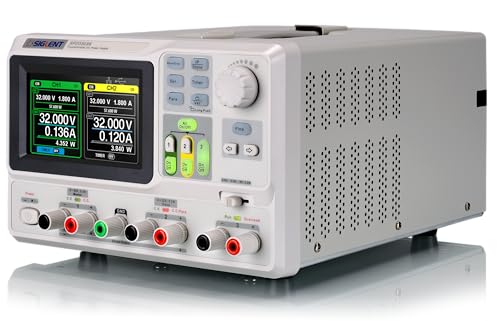
The Siglent is the most complete instrument here for boards that mix voltage domains. Its two main channels are fully adjustable to 32 volts and 3.2 amps, and the third channel switches between 2.5, 3.3, and 5 volts, which covers the logic levels most modern designs actually use without burning a main channel on them. All three outputs are isolated, the main pair can run independently or combine in series and parallel, and the 4.3 inch color display shows every channel at once. USB and LAN ports with SCPI control make it the natural pick when a test has to repeat exactly, run after run.
Specs
- Channels: 3 isolated outputs
- CH1 and CH2: 0 to 32V, 0 to 3.2A each
- CH3: selectable 2.5V, 3.3V, or 5V at 3.2A
- Total output power: 220W
- Display: 4.3 inch TFT-LCD
- Setting resolution: 10mV and 10mA
- Interfaces: USB Device and LAN, SCPI commands, EasyPower software
- Modes: independent, series, and parallel; 5 memory groups
- Weight: 17.6 pounds
Best for: Developers powering a board that needs two adjustable rails plus a modern logic level at the same time.
Watch out for: The third channel only offers the three preset voltages, so a rail like 1.8 volts still has to come from a main channel.
ASIN: B01410O424
Rigol DP832

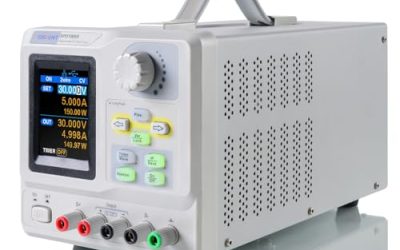
Rigol’s DP832 is the low-noise specialist of this group. Its listing leads with ripple and noise under 350 microvolts rms and a transient response under 50 microseconds, figures that matter when the circuit under test is a sensitive analog front end rather than a motor driver. The first two channels adjust from zero to 30 volts at 3 amps, and the third adjusts from zero to 5 volts at 3 amps, so it is the only unit here whose third channel is continuously adjustable rather than fixed or stepped. A 3.5 inch TFT display, per-channel over-voltage and over-current protection, and built-in voltage, current, and power measurement round out a supply aimed at careful measurement work.
Specs
- Channels: 3 outputs
- CH1: 0 to 30V, 0 to 3A
- CH2: 0 to 30V, 0 to 3A
- CH3: 0 to 5V, 0 to 3A
- Total output power: 195W
- Ripple and noise: under 350 microvolts rms, 2mV peak to peak
- Transient response: under 50 microseconds
- Isolation: CH1 isolated from CH2 and CH3, which share a ground
- Display: 3.5 inch TFT
- Protection: OVP and OCP on each channel
- Weight: 22.8 pounds
Best for: Analog and mixed-signal benches where clean power and an adjustable low-voltage channel matter more than raw current.
Watch out for: Channels 2 and 3 share a ground, and LAN connectivity is an optional extra on this model rather than standard, so check the configuration before relying on either.
ASIN: B09S3GQ24H
KORAD KA3305D
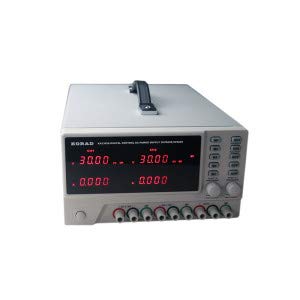
The KA3305D is the value-minded way to get genuinely strong main channels. Each of its two adjustable outputs delivers the full 30 volts at 5 amps — more current than the Siglent or Rigol mains — and the listing states the combined modes plainly: stack the pair in series for 60 volts at 5 amps, or parallel them for 30 volts at 10 amps. A third channel provides a fixed 5 volts at 3 amps for logic. The four-digit LED readouts resolve to 0.010 volts and 0.001 amps, five programmable memory settings recall complete setups at a button press, and the box includes two sets of test leads, so the bench is working the day it arrives.
Specs
- Channels: 3 outputs
- CH1 and CH2: 0 to 30V, 0 to 5A each, continuously adjustable
- CH3: fixed 5V at 3A
- Display: 4-digit LED, 0.010V and 0.001A resolution
- Memory: 5 programmable storage settings
- Modes: independent, series (60V at 5A), parallel (30V at 10A)
- Protection: over-voltage and over-current settings, short-circuit and thermal protection
- Input: switchable 110V or 220V
- Included: power cord, 2 sets of test leads, user manual
- Weight: 15 pounds, 2 year warranty
Best for: Repair and hobby benches that regularly pull several amps and repeat the same setups.
Watch out for: The third channel is fixed at 5 volts with no adjustment, and there is no PC interface, so scripted testing is off the table.
ASIN: B012LMOH0S
Tekpower TP-3005D-3

Tekpower’s TP-3005D-3 keeps the triple-output formula deliberately simple. Two channels adjust from zero to 30 volts at up to 5 amps, a third provides a fixed 5 volts at 3 amps, and the linear regulation design is the traditional low-ripple approach rather than a switching one. Independent, series, and parallel operation are selected with switches on the front panel — both up, both down, or one of each — so there are no menus to learn before the first board powers up. Digital readouts show the settings for each channel, and an automatic thermo-sensor fan handles cooling. It is the pick for buyers who want three honest rails and hardware controls, nothing more.
Specs
- Channels: 3 outputs
- CH1 and CH2: 0 to 30V, 0 to 5A each
- CH3: fixed 5V at 3A
- Design: linear regulated
- Modes: independent, series, and parallel, set by front-panel switches
- Display: digital readouts for voltage and current
- Cooling: automatic thermo-sensor fan
- Sold by: Kaito Electronics through Amazon
Best for: Home and small-shop benches that want 5 amp channels and direct hardware controls without programmability.
Watch out for: There are no memory presets and no remote interface, and the fixed third channel cannot be trimmed to other logic voltages.
ASIN: B00HX0UYBK
Which One Fits Your Situation
You power one board with three different voltages
Choose the Siglent SPD3303X-E. A typical embedded board wants, say, 12 volts for peripherals, an adjustable rail for the section under development, and 3.3 volts for logic. The selectable third channel covers that logic level directly, all three outputs are isolated, and the color display keeps every rail in view at once, so nothing drifts unnoticed while you probe.
You need positive and negative rails for analog circuits
Start with isolation, which points to the Siglent, whose three outputs are all isolated and whose main channels combine in series for split-rail work. The Rigol DP832 also stacks its first channel against the second for a negative rail and adds the cleanest output here, but remember that its second and third channels share a ground when you plan the wiring.
Your loads are hungry and your budget is not
The KORAD KA3305D and the Tekpower TP-3005D-3 both give you two 30 volt, 5 amp channels, which is the most current per channel in this group. Take the KORAD if saved presets and finer current readback will save you time every day; take the Tekpower if you prefer plain switches and the simplest possible front panel.
Your tests run from a computer
The Siglent SPD3303X-E is the automation-ready choice, with USB and LAN ports, SCPI commands, and the maker’s EasyPower software stated right in the listing. The Rigol DP832 offers USB control as standard, but its LAN interface is a paid option on this model, so factor that in if your test rack is networked.
Common Mistakes
- Assuming the third channel is fully adjustable — on most triple supplies it is a fixed 5 volt rail or a short list of preset logic voltages, which changes what it can power.
- Stacking channels for a negative rail without checking isolation, then discovering two of the outputs share a ground.
- Adding up the per-channel ratings and expecting them all at once, when the supply’s total power figure — 195 or 220 watts here — is the real ceiling.
- Choosing by voltage range alone and ignoring display resolution, so a sleeping circuit’s small current draw never registers on the readout.
- Leaving the series or parallel mode switches set from the last job and powering a board with double the intended voltage.
Frequently Asked Questions
What is a triple-output bench power supply used for?
It powers circuits that need several voltages at once: an adjustable rail for the section being developed, a second rail for peripherals or a motor stage, and a low-voltage rail for logic. One instrument replaces two or three single supplies, keeps every rail visible in one place, and lets the main channels combine when a single rail is not enough.
Is the third output adjustable like the other two?
Usually not, and the four supplies here show the range of answers. The KORAD and Tekpower third channels are fixed at 5 volts, the Siglent’s third channel switches between 2.5, 3.3, and 5 volts, and only the Rigol’s third channel adjusts continuously from zero to 5 volts. Check the listing wording before assuming a third channel can be trimmed to an unusual voltage.
Can two channels make a higher voltage or a negative rail?
Yes, provided the channels are isolated from each other. Wiring two isolated channels in series adds their voltages — the KORAD listing quotes 60 volts at 5 amps this way — and grounding the midpoint of a series pair creates positive and negative rails for analog work. Channels that share a ground, like the Rigol’s second and third, cannot be stacked against each other.
Why do these supplies use linear regulation instead of switching?
All four picks here are linear designs, and the listings show why: the Rigol quotes ripple and noise under 350 microvolts rms, far below what typical switching supplies publish. Linear regulation suits sensitive analog and measurement work. The trade-off is size and weight — these are heavy transformer-based instruments, so plan bench space and shelf strength accordingly.
More from Amazon
Programs that pair well with the guide above. Offers and eligibility are set by Amazon and may change.
Free shipping on eligible items, Prime Video and more. Eligible new members can start with a free trial.
Start a Prime free trialAudiobooks and podcasts to listen to on the go. Eligible new members can start with a free trial.
Try Audible freeAd-free music streaming. Eligible new subscribers can start with a free trial.
Try Music Unlimited freeA free business account with business pricing and bulk-buying tools for work, shop or home office.
Create a business accountAs an Amazon Associate we earn from qualifying purchases.







Write Your Review
No reviews yet. Be the first to share your experience!