

Key takeaways
- Compare the best triple-output bench power supplies for electronics laboratories: three channels, clean linear power and clear advice on choosing well.
Choosing a triple-output bench supply is really a decision about how your laboratory powers boards that need several rails at once. A mixed-signal prototype might want a positive analog rail, a negative analog rail and a separate logic feed, all live at the same time. The real questions are whether the third channel must be fully adjustable or can be a fixed logic output, whether the channels are isolated from each other, and whether the total power budget covers every rail running together.
This guide is for electronics laboratories in teaching, research and development, and service work, where one instrument often has to feed a whole experiment from a single bench position. Every product below is a genuine triple-output unit, and each one was chosen from the names and specifications printed on its Amazon product page, so the channel ratings, display details and output modes described here match what the listing itself states.
Quick Picks
As an Amazon Associate we earn from qualifying purchases.
| Product | Best for | Key spec from title |
|---|---|---|
| Siglent Technologies SPD3303X-E | Shared lab benches needing isolated rails and a colour display | Triple output, 220 W total |
| Rigol DP832 | Development benches wanting three adjustable channels | Triple Output 195 Watt Power Supply |
| Siglent Technologies SPD3303C | Teaching labs wanting clear readouts and simple controls | Triple output, 220 W total |
| Tekpower TP-3005D-3 | Budget benches needing higher current on two channels | 0-30 Volts at 0-5 Amps |
How to Choose
Channel Layout: Adjustable or Fixed Third Output
The first decision is what the third channel does. Some supplies give you two adjustable channels plus a third output that only offers a few selectable logic voltages, which suits boards whose digital side always runs at a standard rail. Others make all three channels fully adjustable, which matters when a sensor, a reference circuit or a second analog section needs an unusual voltage. Check the listing carefully: a unit described as triple-output can still limit its third channel to fixed steps, and that single detail decides whether it fits your typical board or fights it.
Isolation and Series or Parallel Modes
Isolation decides how freely you can wire the outputs. Fully isolated channels can be stacked to build a higher voltage, paralleled for more current, or arranged as positive and negative rails around a ground point for op-amp circuits. Where channels share a common terminal, some of those arrangements are impossible or need care. Listings state the output modes a unit supports, such as independent, series and parallel, so match those modes against the configurations your laboratory actually uses rather than assuming every triple-output supply can be combined in every possible way.
Resolution, Readout and Output Cleanliness
Setting resolution tells you how finely you can dial in a rail, and readback digits tell you how confidently you can confirm it. A teaching bench may be fine with coarser steps, while development work on sensitive analog stages benefits from finer adjustment and more display digits. Because these are laboratory instruments, output cleanliness matters too: linear designs are valued for low ripple and noise, which keeps supply artefacts out of measurements. Compare the resolution figures and display type printed on each listing, and favour the readout style your team can read quickly and without mistakes.
Total Power, Size and Daily Workflow
Add up the rails before you buy. Total output power is shared across the channels, so a supply that looks generous per channel may still limit you when all three outputs run hard together. Physical size matters as well, because laboratory bench depth is finite and these linear units are heavy. Finally, think about workflow: stored setups help when classes repeat the same experiment, a clear display reduces setting errors between users, and remote interfaces help when the supply sits inside an automated rig rather than being adjusted by hand all day.
The 4 Best Options
Siglent Technologies SPD3303X-E
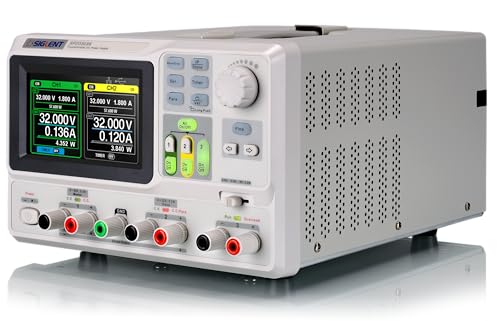
The SPD3303X-E suits a shared laboratory bench where several people power different boards across the day. Its two main channels adjust across a wide range for analog and digital sections, while the third output covers the standard logic voltages most microcontroller and logic boards expect. Because all three outputs are independent and isolated, one user can run split rails for an amplifier stage while the next powers a single-rail controller, and the colour display keeps every channel’s settings visible at a glance for whoever walks up next.
Specs
- 3 independent, controlled and isolated outputs
- Two adjustable channels at 32 V / 3.2 A each
- Third output selectable at 2.5 V, 3.3 V or 5 V at 3.2 A
- Total output power: 220 W
- Model number: SPD3303X-E
Best for: General-purpose laboratory benches that power mixed analog and logic boards.
Watch out for: The third channel only offers the listed selectable voltages, so confirm your logic rail is one of them before ordering.
ASIN: B01410O424
Rigol DP832

The DP832 is the pick for development benches where the third channel has to be a real working output rather than a fixed logic feed. All three channels adjust, so a prototype needing, say, a main rail, a lower analog rail and a small auxiliary voltage can be powered without borrowing a second instrument. Its channel ratings are balanced rather than extreme, which fits the steady, moderate loads typical of board bring-up and validation work, and the built-in timing and measurement functions on the listing suit benches that run repeated power-up sequences.
Specs
- 3 outputs with total power up to 195 W
- Channel 1: 0 to 30 V / 0 to 3 A
- Channel 2: 0 to 30 V / 0 to 3 A
- Channel 3: 0 to 5 V / 0 to 3 A
- Model: DP832
Best for: Research and development benches that need three adjustable outputs on one instrument.
Watch out for: Two channels share a common connection on this design, so check your grounding plan if every rail must float independently.
ASIN: B00ENX02GC
Siglent Technologies SPD3303C
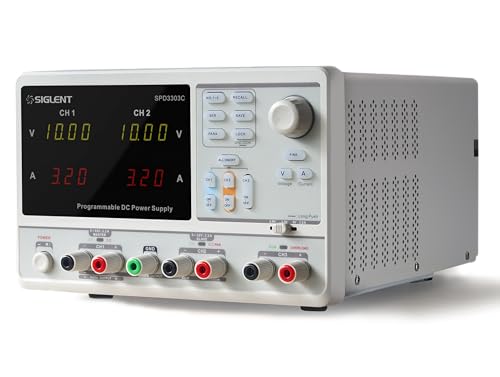
The SPD3303C covers the same triple-output layout as its sibling above but presents it through straightforward LED readouts, which many teaching and service laboratories prefer. Four displays show voltage and current for the two adjustable channels, so a student or technician can confirm both rails without cycling through screens. The third output handles the usual logic voltages, the output modes cover independent, series and parallel wiring, and the USB interface with the included software gives an instructor or lab manager a simple route to repeatable, documented setups.
Specs
- Triple output with 220 W total power
- Two adjustable channels at 0-32 V / 0-3.2 A
- Third output selectable at 2.5 V, 3.3 V or 5 V at 3.2 A
- Four displays with voltage and current readout for channel 1 and channel 2
- Output modes: series, independent and parallel
- USB interface with EasyPower software included
- Resolution: 10 mV / 10 mA
Best for: Teaching and service laboratories that value clear readouts and simple, repeatable operation.
Watch out for: There is no colour screen or network port on this model, so choose the X-E version if your bench needs those.
ASIN: B01HENYNZS
Tekpower TP-3005D-3

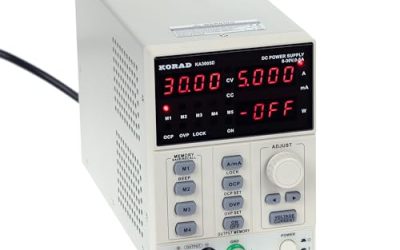
The TP-3005D-3 is the straightforward, budget-conscious route into triple-output power for a laboratory that needs current more than refinement. Its two main channels deliver up to 5 A each, which suits loads such as motor drivers, lighting rigs and power stages that would strain a 3 A supply, and they can be connected in series or parallel when a single rail needs more voltage or current. The third output provides a fixed 5 V feed for logic, and the linear design keeps output noise low for a unit at this level.
Specs
- Two adjustable outputs at 0-30 V / 0-5 A, connectable in series or parallel
- Third output: fixed 5 V at up to 3 A
- Constant voltage and constant current operating modes
- Back-lit LCD display with 0.1 V and 0.01 A resolution
- Cooling fan activates automatically through a built-in thermo-sensor
- Input voltage: 110 V AC
Best for: Budget laboratory benches and training setups whose loads draw more current on the main channels.
Watch out for: The listing is a 110 V input model, so confirm your laboratory mains supply matches before ordering.
ASIN: B00HX0UYBK
Which One Fits Your Situation
Powering a Mixed-Signal Prototype Board
For a board combining analog stages with a logic section, the Siglent SPD3303X-E is the natural fit. Its two adjustable isolated channels can form split rails for the analog side while the selectable third output feeds the digital side at a standard logic voltage. Everything runs from one instrument, the colour display shows all three rails together, and stored setups make it easy to return to the same power arrangement each time the prototype comes back to the bench.
Running a Teaching or Training Laboratory
In a teaching laboratory, the Siglent SPD3303C earns its place through clarity. Separate LED readouts for both adjustable channels let students verify their settings at a glance, the selectable third output covers the logic voltages used in coursework, and the controls stay simple enough for a new class to learn quickly. The USB interface and included software also help instructors prepare identical setups across several benches before a session begins.
Servicing Boards With Several Rails
Repair and service work often means feeding a faulty board exactly the rails it expects, including an odd auxiliary voltage. The Rigol DP832 handles that best here because all three of its channels adjust, including the low-voltage third channel. A technician can reproduce a board’s original power arrangement on one instrument, watch consumption on each rail separately, and spot the channel whose behaviour points toward the fault.
Feeding Higher-Current Loads on a Budget
When the work is less about fine resolution and more about current, such as driving motors, lamps or power electronics stages during laboratory exercises, the Tekpower TP-3005D-3 is the sensible choice. Its main channels supply up to 5 A each, the fixed third output covers logic duties, and the linear design keeps the power clean enough for general bench work without paying for programmability your exercises will never use.
Common Mistakes
- Assuming every triple-output supply has three fully adjustable channels, when many designs make the third output a fixed or selectable logic rail only.
- Adding up per-channel ratings and forgetting that total output power is shared, so all three channels cannot always run at their maximum together.
- Ignoring channel isolation, then discovering the outputs cannot be stacked into split rails or combined for higher voltage in the way the experiment requires.
- Choosing by headline voltage alone and overlooking setting resolution, which decides how precisely a sensitive rail can be dialled in and repeated.
- Forgetting to check the input voltage and bench space, since these linear units are heavy and some listings are built for one mains standard only.
Frequently Asked Questions
Does a triple-output supply replace three separate supplies?
For most bench work, yes. One triple-output instrument powers three rails at once, takes a single bench position and gives you one place to set limits and read consumption. Separate supplies still make sense when rails must sit in different rooms or when one load needs far more power than a shared total budget allows, but a single unit covers the everyday multi-rail case neatly.
What is the third channel usually for?
On many models the third channel is a logic rail, offering a small set of selectable voltages suited to digital circuits, microcontrollers and interface chips. That frees the two main adjustable channels for analog sections or higher rails. Some supplies instead make the third channel fully adjustable, which helps when an auxiliary circuit needs a non-standard voltage, so check the listing against the boards you power most often.
Can the channels be combined for more voltage or current?
Often, yes, provided the channels are isolated and the listing states series or parallel modes. Wiring two channels in series raises the available voltage, while paralleling them raises the available current, and isolated outputs can also form positive and negative rails for op-amp circuits. Always confirm the supported modes and the combined limits on the product page rather than assuming a wiring trick is safe.
How much total power does a laboratory bench actually need?
Start from the boards you power, not the headline ratings. Add the voltage multiplied by the current for each rail at its realistic working load, then leave headroom for start-up surges. Many prototype and teaching loads sit comfortably within a couple of hundred watts shared across three channels, while power stages and motor work can exceed that quickly, which is when a higher-current model becomes the safer choice.
More from Amazon
Programs that pair well with the guide above. Offers and eligibility are set by Amazon and may change.
Free shipping on eligible items, Prime Video and more. Eligible new members can start with a free trial.
Start a Prime free trialAudiobooks and podcasts to listen to on the go. Eligible new members can start with a free trial.
Try Audible freeAd-free music streaming. Eligible new subscribers can start with a free trial.
Try Music Unlimited freeA free business account with business pricing and bulk-buying tools for work, shop or home office.
Create a business accountAs an Amazon Associate we earn from qualifying purchases.








Write Your Review
No reviews yet. Be the first to share your experience!